


Eyeglass Mold Fees: Buyout vs Amortization vs Rebate
By Cedric | Leeyewear

A European buyer came to us last year with a problem that had nothing to do with frame quality. Two years earlier, his brand had paid $7,400 for a TR90 mold at another factory. The relationship ended. When his team went to collect the mold, the factory presented a bill: two years of storage at 8% per year, plus a 12% "re-commissioning" fee to release it. The clauses had never been discussed, because at tooling kickoff both sides were busy with deadlines, and the mold fee felt like a one-time cost. It is not a one-time cost. How you pay it decides who owns the steel, who holds the drawings, and what happens when the cooperation ends.
If you manufacture custom eyeglass frames, the eyeglass mold fee is usually the first significant payment you make. This article covers what we actually see at the negotiating table: current price benchmarks, the three structures factories offer, and the contract terms that matter long after the samples are approved.
Acetate Is the Exception
Before any numbers: acetate frames are CNC-machined from sheet, so there is no injection mold involved. The cost covers cutters, fixtures, and programming time. Figure a few hundred dollars up to roughly $3,300.
The real tooling money sits with injection-molded frames in TR90, PC, and nylon. A complete set normally means a front cavity plus left and right temple cavities, often built multi-cavity. More cavities and complicated hinge geometry push the price up. In our experience, a full set runs from a few thousand dollars to around $20,000.
One check that saves buyers real money: when a quote shows a "tooling fee," ask whether it pays for a brand-new mold or for modifications to an existing stock mold. New tooling deserves the negotiation below. If the design comes off a stock mold, that line should read zero.
What Tooling Costs Now
A complete frame mold includes the front cavity, both temple cavities, nose-pad inserts, and hinge-positioning inserts. Prices move with steel and with complexity. The ranges below reflect tooling quotes we and peer factories around Shenzhen and Dongguan have issued over the past three years; steel prices spiked hard in 2021 and 2022, and titanium tooling has not fully come back down since.
|
Mold Type |
Typical Material |
Approx. Price (USD) |
Lead Time |
Typical Production MOQ |
Best For |
|---|---|---|---|---|---|
|
Standard single-cavity injection mold |
TR90, PC, nylon |
$1,800–3,300 |
15–20 days |
1,000–2,000 pcs/style |
Basic optical frames, entry-level sunglasses |
|
High-end injection mold (multi-slide, high-gloss, overmold) |
Engineering plastics, two-tone materials |
$6,800–12,000 |
25–35 days |
2,000–3,000 pcs/style |
Premium fashion frames, functional eyewear |
|
Standard metal stamping/casting die |
Alloy, stainless steel |
$3,300–9,800 |
20–28 days |
800–1,500 pcs/style |
Regular metal optical frames, sunglasses |
|
High-end titanium precision mold |
Pure titanium, β titanium |
$9,000–18,000 |
30–45 days |
500–1,000 pcs/style |
Premium titanium frames, luxury optical |
|
Acetate CNC fixtures |
Acetate sheet |
$600–3,300 |
10–18 days |
300–500 pcs/style |
Acetate frames, premium handmade styles |
|
Stock mold (existing design) |
All materials |
$0 |
7–10 days |
Per factory's existing MOQ |
Basic programs with no customization |
Two honest notes on the table. First, two factories can quote the same project 20–30% apart and both be legitimate; cavity steel and polish hours explain most of the spread. Second, a detailed quote (steel grade, cavity count, included inserts, modification terms) costs the factory real engineering time, and factories spend that time where the inquiry shows intent: drawings, a target price, estimated volume. A one-line "please quote" gets a range, and the range is worth what you paid for it.
Structure One: Buyout - You Pay, You Own
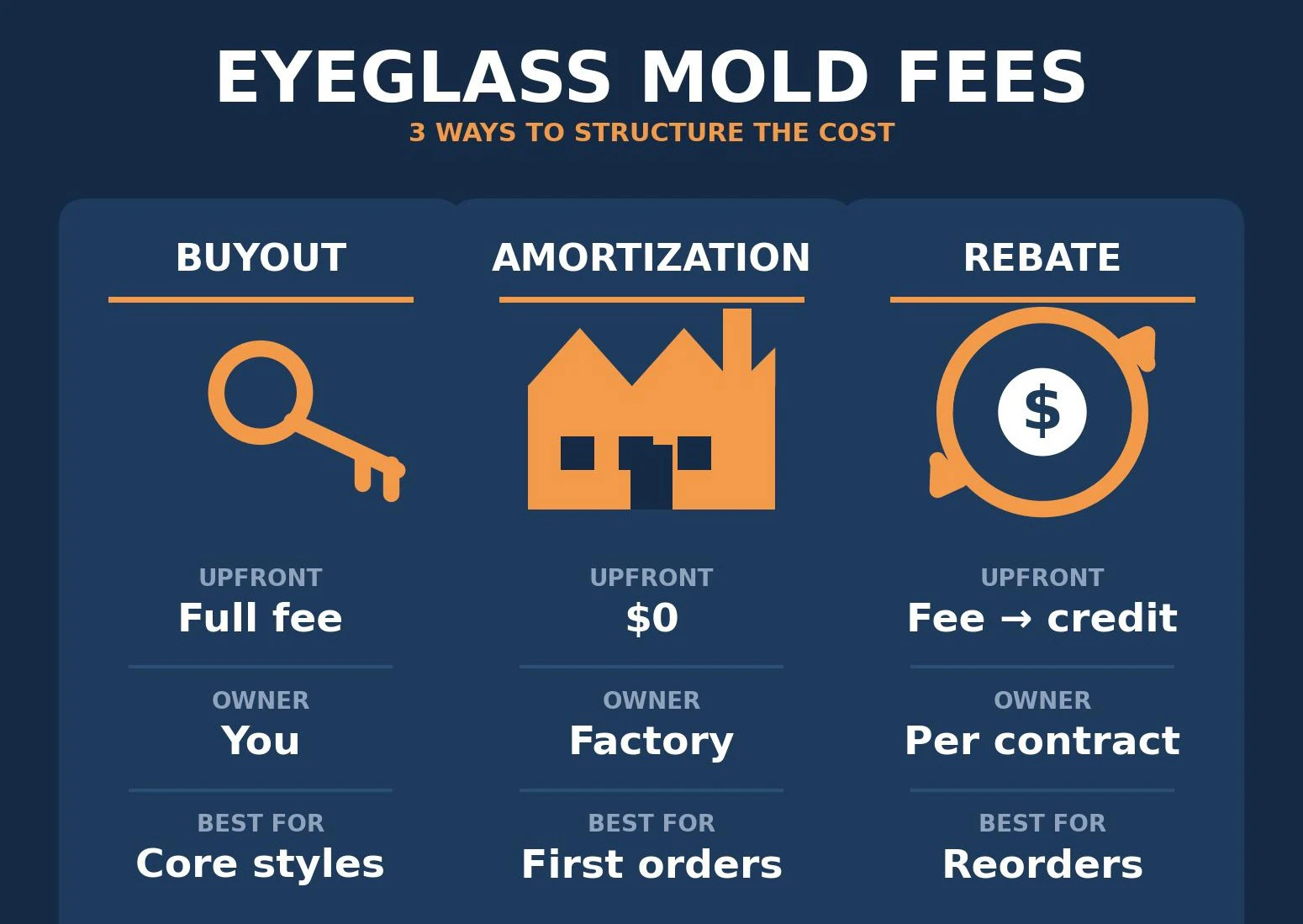
Buyout means the full fee is paid within one program and the mold becomes your property. The factory stores and maintains it and cannot run it for any third party without your written authorization.
The standard payment schedule we see is four stages: about 30% at signing to start tooling, 30% when T1 samples pass dimensional and cosmetic checks, 30% when a short trial run hits the agreed yield, and the final 10% after three clean months of mass production. The staged structure protects both sides, and we would be cautious about any factory asking for 100% upfront.
The story that opens this article is a buyout story. Once the fee is paid, the mold is yours, which is precisely when the two neglected clauses start costing money. Storage: many factories charge 5–10% of the mold cost per year for keeping it (rust prevention, humidity control, periodic upkeep), though the fee usually disappears when your annual purchases with that factory pass $100,000. Transfer: when cooperation ends, you can retrieve the mold, but some factories charge 10–15% to release and re-commission it. Set both numbers in writing before the first payment, not after the last one.
One more asset buyers routinely forget: the data. If you pay for the mold but walk away with only physical samples, the STEP and IGES files stay with the factory. We have watched a program stall for six weeks over "lost" 3D data during a supplier change. Get the files at kickoff, and the clause about it costs nothing.
Buyout earns its keep when annual volume is solid, the style has a long life, confidentiality matters, or you may want two factories running the same frame.
Structure Two: Amortization - The Factory Carries It
Under amortization, no tooling line ever appears. The fee spreads across an agreed quantity inside the unit price, and the factory recovers its money through production. Your upfront spend is zero; you order at the agreed MOQ.
The arithmetic decides whether this is a good deal, and buyers get it wrong in one direction: they compare unit prices without asking what is inside them. An $8,000 mold amortized over 10,000 frames across two years adds $0.80 per frame. Over 3,000 frames, it is $2.67. Same mold, three times the load, and the difference only shows up if you ask each factory to break the unit price down.
Market practice works in tiers around 1,000, 3,000, and 5,000 pieces, tied to MOQ. The declining version is now common: full amortization on the first 1,000 pieces, half on pieces 1,001–3,000, nothing beyond 3,000, with the unit price dropping automatically. Ask about cross-year accumulation as well. Some factories let a style's volume carry over across orders; others reset every January, which quietly moves real money on a slow-building style.
The trade-off is ownership: the mold belongs to the factory, and your usage rights end the day you switch suppliers. Amortization is a low-commitment way to test a style. For first orders, small trial runs, and unproven designs, it is usually the right call.
Structure Three: Rebate - Pay Now, Get It Back in Volume
A rebate structure has you pay the full fee at the start. Once cumulative orders cross an agreed threshold, the factory returns a set percentage, normally as a credit against future invoices rather than cash.
Full one-step rebates are rare now. What we negotiate looks more like a ladder: 30% back at 2,000 cumulative pieces, 70% at 4,000, full rebate at 6,000. Thresholds scale with complexity, roughly 3,000 pieces for a basic style and 8,000–10,000 for high-end constructions. The validity window is usually 18 months, and here is where rebate deals quietly die: a new style often takes 12 months to find its level, and the window expires before the volume arrives. Push to remove the window or extend it to 36 months. Define "reorder" as cumulative quantity on the same SKU, so a new purchase-order number cannot reset the count. And write the credit to apply against payment directly.
The ladder is negotiable. On a $10,000 tooling program, $5,000 back at 10,000 units and full rebate at 20,000 is achievable when the forecast behind it is credible. Bring the forecast to the table; factories respond to numbers they can check.
This route fits a style you already know will reorder, or a program moving out of test marketing into steady production.
If You Remember Nothing Else
Forecast under 3,000 pieces over the mold's life: take amortization. Confident above 30,000: take buyout and treat the mold as an asset. Confident in volume but protecting cash: the rebate structure reduces the initial outlay and erases the tooling cost once the threshold is reached.
The Five Clauses That Decide Who Controls the Mold
The mold sits in the factory's warehouse for years; everything depends on what the contract says before problems start. Five items, in the order they cause trouble:
- Ownership and milestones. Tie transfer of ownership to payment stages, in writing. Payment alone does not move the steel.
- Storage and maintenance. Who pays if the mold rusts or is damaged. The European buyer at the top of this article skipped this one and paid 8% a year for the privilege.
- Lifespan and repair. A stated shot-life commitment, and who covers normal wear. For a frame mold, ask for the guarantee in shots (a well-kept steel mold runs into the hundreds of thousands), not years.
- Data. Drawings and 3D files belong to the buyer, with backup available on request. We hand STEP files over before the final payment leaves the buyer's account; a factory that hesitates at this clause is telling you something.
- End of cooperation. The buyer gets a set window (60 days is customary) to retrieve the mold or witness its destruction. No unilateral disposal.Put the acceptance criteria in the same document: ±0.10 mm dimensional tolerance for standard styles, ±0.05 mm for high-precision work, and a yield ladder for trial runs - roughly 85–90% at T1/T2, ramping to 95% or better in mass production.

A Quick Break-Even Check
Mold cost per frame = tooling fee ÷ total frames expected over the mold's life. Below 1% of the unit price, the structure barely matters. Above 3%, negotiate seriously.
Worked example: a TR90 sports frame needs a $12,000 mold. Buyout works out to $3.20 per frame, amortization to $3.60. The $0.40 gap closes at 30,000 frames. Under that, amortization keeps the downside small. Over it, buyout wins. And a paid-up mold can also be locked to you exclusively - off the factory's website, out of the sample room - for the cost of carrying it yourself.
Moves That Work at the Table
When capacity is loose, commodity-style tooling often carries 10–15% room off the benchmark. On high-end custom work, confirm scope line by line, and ask for the 3D structural verification and first trial molding to be included rather than billed separately. Long-running programs can trade annual volume for a lower amortization ratio, a higher rebate ratio, or a waived storage fee. First-time buyers should ask for the opening order to count toward the rebate threshold. On 3D-printed prototypes, the first structural set is usually free; beyond two modification rounds, $50–120 per round is normal, so agree the number early. Color changes off the same mold, logo plate charges, and shared compliance costs should each sit on their own line - testing, in particular, is arranged per destination market and customer requirements once the order is placed, and it should never be buried in the unit price.
Last, hold the rebate threshold up against your own sales forecast. A threshold beyond realistic volume is a rebate on paper only.
How We Handle Tooling at Leeyewear
The mold fee is always itemized as its own line on our quotes, and all three structures are open for discussion. Every mold we hold carries a maintenance log with the shot count recorded at each production run, so a buyer can check usage at any time. Data ownership is written into the contract and the STEP/IGES files are handed over before the final payment. Rebate terms carry no hidden validity windows. Mold photos and trial samples go to the buyer as work progresses.
If a custom frame project is on your desk, drawings plus an estimated volume are enough to start a specific conversation about it.
Questions Buyers Actually Ask
How much does an eyeglass mold cost?
A standard single-cavity TR90/PC/nylon mold runs $1,800–3,300; high-end multi-cavity tooling $6,800–12,000; titanium precision molds $9,000–18,000. Acetate uses CNC fixtures at roughly $600–3,300 instead. A stock mold should cost nothing.
Who owns the mold, and can I move it?
Paid it off under a buyout? It is yours, though expect a 10–15% transfer and re-commissioning fee, agreed in advance. Went the amortization route? It belongs to the factory, and you leave it behind. Either way, the drawings and 3D files decide whether the mold is actually usable anywhere else, so secure those first.
Is the mold fee refundable?
Rarely in cash. Rebate ladders return 30–100% as invoice credits once cumulative volume crosses the thresholds - around 3,000 pieces for basic styles, 8,000–10,000 for complex ones. Check the validity window and the SKU definition before counting on it.
Do acetate frames need a mold?
No. CNC machining cuts them from sheet, so the tooling conversation becomes one about cutters, fixtures, and data ownership instead.