


Which Eyewear Frame Materials Hold Up Best Against Sweat and Corrosion in Hot, Humid Climates?
Leeyewear
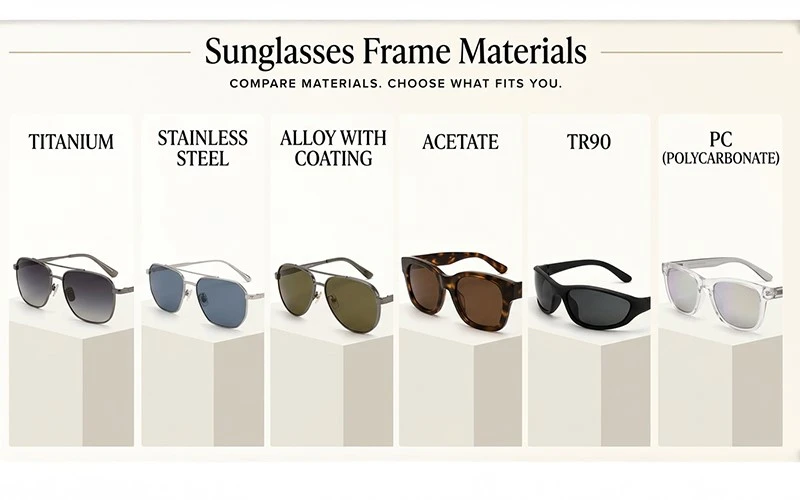
A frame can fail inside a shipping container before a single customer tries it on. That sounds dramatic, but it happens. Containers parked at ports in Southeast Asia or the Gulf can sit above 50°C with 80% relative humidity for weeks. Then the frames reach the market, where sweat - salty, slightly acidic, held against the temples and nose pads for ten hours a day - finishes the job.
Buyers in hot, humid markets know the symptoms well: plating bubbles near the hinges, greenish marks where the rim touches the cheek, acetate fronts that slowly warp out of shape. Returns come first. Bad reviews follow. Most of this damage is decided at the material and specification stage, long before the frames ship. This guide compares the main eyewear frame materials for hot, humid climates - which ones deliver truly corrosion-resistant eyeglass frames, and which ones only look good on the spec sheet - and explains how to write the requirements into an OEM or ODM order.
Why Sweat and Humidity Break Frames Faster Than Most People Expect
Sweat is roughly 99% water. The other 1% is what causes the damage: sodium chloride, urea, lactic acid and fatty acids, with a pH typically between 4.5 and 6.5. None of this matters while it evaporates. The trouble starts in the crevices - around hinges, under nose pads, along the inside of the temple tips - where a thin moisture film stays active for hours.
Left long enough, that film works its way through microscopic pores in plating and attacks the base metal underneath. Humidity keeps the film alive overnight, so the corrosion never really stops. This is why the first failures almost always appear at the hinge barrel and the nose pad arm, not on the front of the frame where sweat gets wiped away.
Heat adds a second problem. A closed car in summer can pass 60°C inside. Injection-moulded materials such as TR90 handle this comfortably, but many acetate formulations begin to soften in the 50–60°C range. A frame left face-down on a hot dashboard can take a permanent set under its own weight. Metals stay dimensionally stable at these temperatures. Their surface finishes do not, and a hot, humid warehouse weakens thin or poorly bonded coatings faster than any lab cycle.
The ISO 12870 Perspiration Test, Explained Honestly
ISO 12870:2024 includes a resistance-to-perspiration test, and it is worth understanding exactly what it involves. Frames are suspended at least 12 mm above an artificial sweat solution, held at 55°C ± 5°C. After 8 hours the frame should show no spotting and no obvious colour change - loss of gloss is acceptable - on any part except joints and screws. The test then continues to a total of 24 hours, after which parts in prolonged skin contact must show no corrosion, surface degradation or coating separation.
Two points matter for sourcing. First, the standard checks two milestones, 8 hours and 24 hours, so a report quoting only the 8-hour result tells you half the story. Second, a pass in the lab is a controlled, single-cycle exposure. Real life adds sunscreen, seawater spray at the beach, repeated wiping, and months in humid storage. A frame that passes 24 hours in artificial sweat can still develop problems in the field, which is exactly why the process controls further down this page matter as much as the material name.

Eyewear Frame Materials Compared for Sweat and Corrosion Resistance
The table below compares the five material families used in corrosion-resistant eyeglass frames most often. The descriptions refer to properly made frames from controlled production; a cheap frame in an expensive material still fails.
|
Frame material |
Behaviour against sweat and corrosion |
Heat and shape stability |
Typical product positioning |
|---|---|---|---|
|
Titanium / beta-titanium |
Strong natural resistance; oxide layer self-repairs; plated decorative parts still need checking |
Dimensionally stable across normal use temperatures |
Premium metal collections |
|
316L stainless steel |
Good chloride resistance when the surface is sound; pores in plating expose the base metal |
Stable; performance depends on grade and finish |
Mid-range metal collections |
|
Plated base-metal alloys |
Entirely dependent on the plating system: underlayer, top layer and adhesion |
Stable substrate; the finish is the weak point |
Cost-driven everyday frames |
|
Cellulose acetate |
Does not rust; hinges, screws and inlays face the same sweat exposure as metal frames |
Softens in the 50–60°C range depending on formulation |
Fashion and premium collections |
|
TR90 / nylon (polyamide) |
The polymer itself does not corrode; metal inserts and hinges still require verification |
High heat-deflection grades stay stable in cars and warehouses |
Sports and lightweight daily wear |
Titanium Frames: The Benchmark for Corrosion Resistance
Titanium forms a dense oxide layer on its surface, and the layer reforms within seconds if it gets scratched. This gives titanium frames a natural defence against sweat that no plating can match, because the protection is the metal itself. The density helps too: titanium runs about 4.5 g/cm³ against roughly 8.0 g/cm³ for steel, so a titanium frame carries noticeable weight savings.
Pure titanium and beta-titanium differ in practice. Pure titanium takes a clean weld and holds a polish; beta-titanium is more flexible, which makes it popular for slim temple designs that need to flex without permanent deformation. Two details deserve attention on any titanium order for eyeglass frames. First, decorative plated parts on a titanium frame - logos, ring inlays - lose the titanium advantage and need the same plating checks as any metal frame. Second, mixing titanium with stainless screws in a sweat-wet crevice sets up a small galvanic couple. It rarely causes visible damage in normal wear, but it belongs in the design review for high-sweat applications.
The material cost sits at the top of the metal range. For eyeglass frames sold in coastal cities or to sports users, the lower corrosion risk and the premium positioning usually justify it.

Stainless Steel Frames: The Practical Middle Ground
For eyeglass frames, 316L earns its place through molybdenum, which improves resistance to chlorides - the active ingredient in sweat. Grade 304 costs less and corrodes faster in the same conditions, so the alloy designation belongs in the purchase order, not just the word "stainless."
The weak points are predictable: welded joints where the surface state changes, and any plated area where pores let sweat reach the base metal. Stainless steel frames with good plating sit comfortably between plated alloys and titanium on both price and long-term appearance in humid markets.
Plated Base-Metal Alloys: Where Corrosion Resistance Is Bought, Not Inherited
Copper-nickel-zinc based alloys keep frame costs down, and they machine and polish well. They also corrode readily on their own, so every hour of sweat resistance comes from the plating stack: the underlayer, the barrier layer and the top finish, plus how well each one adheres.
Thin or porous plating fails in weeks of daily wear. Adding thickness alone does not fix porosity, because a thick layer full of pinholes still lets sweat through to the base metal. What lasts is a complete system - clean substrate preparation, adequate underlayer, top layer appropriate to the design - produced under stable bath conditions. That is why two frames with identical material names on the spec sheet can age very differently, and why the plating requirements deserve their own lines in the technical specification.
Acetate Frames: Beautiful, Rust-Free, and Sensitive to Heat
Cellulose acetate gives colour depth and polish that injection materials struggle to match, which keeps it standard for fashion ranges. It never rusts, and that is genuinely useful in humid climates. The metal inside it - hinges, screws, wire cores, decorative inlays - faces exactly the same sweat exposure as a full-metal frame, so the hardware needs the same specification.
The heat behaviour is the real constraint. Depending on the formulation and plasticizer content, many acetate sheets begin to soften in the 50–60°C range, and a frame stored in a hot car or a sun-baked warehouse can lose its shape. Always verify dimensional stability on finished frames. Raw sheet data will not tell you how the frame behaves after cutting, tumbling and polishing, because residual stress from processing changes how it responds to heat.
TR90 and Nylon Frames: The Lightweight Workhorses
TR90 is a transparent polyamide, PA12-based, and its two numbers matter for tropical use: water absorption well below 1%, and heat-deflection temperatures above 100°C for the common frame grades.
A TR90 frame survives a hot car interior that would leave an acetate frame permanently bent, which is why so many sweat-resistant eyeglass frames for sports use are built on this material.
The density runs around 1.0–1.2 g/cm³, which is where the "feather-light" feel comes from. Two honest caveats. First, the hinge and any metal insert inside the frame still face sweat, so "TR90 frame" never means "no metal to check." Second, TR90 is a trade name used loosely in the market. Ask for the resin grade and the finished-frame test results, because quality between suppliers varies more than the label suggests.

Where Sweat Damage Actually Starts: Process, Design and Consistency
Two frames with the same material name on the drawing can age years apart. The differences live in three places.
Plating quality decides how long a metal finish survives daily sweat. Design decides where moisture sits - closed hinge barrels, unventilated nose pad cups and deep crevice angles all trap the sweat film. Production consistency decides whether batch fifty matches batch one, because a change of resin lot or a fresh plating bath without requalification can quietly shift the outcome.
Writing these variables into the technical specification protects both sides. The buyer knows what will arrive; the factory knows exactly what it is being paid to deliver.
Which Eyewear Quality Tests to Request - and How to Ask
A short, specific request gets a useful answer. Vague requests get marketing PDFs.
Resistance to perspiration, ISO 12870:2024. Ask for the full 24-hour result with both checkpoints stated, and confirm the artificial sweat composition and 55°C ± 5°C exposure temperature were followed. Ask for photos of the frames after the test, not only a pass/fail line.
Nickel release, EN 16128. For EU-bound frames, parts in direct and prolonged skin contact must stay below 0.5 µg/cm²/week under REACH Annex XVII. "Nickel-free" on a plating description is a process claim; only release testing on the finished component confirms compliance.
Dimensional stability, ISO 12870. Finished frames hold at 55°C ± 5°C for 2 hours, with temple-tip movement inside the standard's limits. This test matters most for acetate.
Salt spray, ASTM B117. Many buyers of plated frames ask for 24–48 hours of neutral salt spray before approving production.
Coating adhesion. Cross-cut or tape testing on plated and coated surfaces catches weak finishes that pass visual inspection.
As a factory, we arrange these tests against each order's destination market and the customer's own requirements, and we report the results accordingly. Talking through the test plan before sampling saves everyone a redo.
Writing the Specification into Your OEM/ODM Order
Four details turn a polite request into an enforceable one:
- State the target climate and use. "Southeast Asia, everyday and sports wear" tells the factory more than "good quality."
- Name exact materials. Alloy designation or resin grade, plating stack and surface treatment. Vocabulary like "high-quality plating" cannot be tested, and untestable requirements always end in disagreement.
- Define the tests, acceptance limits and who performs them, on samples and on production batches. Approve sealed samples and test reports as the reference for later batches, and require written approval for any material or process change.
- Compare total quality cost. A frame that costs 40 cents more but returns at half the rate is the cheaper frame over a season.
Which Material Fits Which Product Line
Budget everyday metal frames: well-controlled plated alloys or 316L, with the plating stack specified and salt-spray results on file.
Fashion acetate collections: entirely workable in the tropics, provided finished-frame heat-stability data exists and the hardware is specified properly. Storage and shipping conditions still need attention.
Premium metal collections: titanium earns its cost in coastal and high-sweat markets through corrosion margin and positioning.
Sports and high-activity frames: TR90 or comparable polyamide, with the resin grade and metal inserts verified before approval.
Frequently Asked Questions
Which eyeglass frames are the most corrosion-resistant?
Titanium and its alloys lead the field for corrosion-resistant eyeglass frames because the protective oxide layer repairs itself. Stainless steel of the right grade follows, and plated alloys last as long as their plating does.
Are titanium frames better than stainless steel in humid climates?
For corrosion margin and weight, yes. For budget-limited lines, properly specified 316L remains a sound choice.
Does TR90 resist heat and sweat?
The common frame grades handle car-interior heat and show very low moisture absorption. The hinges and inserts still need checking, and the specific resin grade should be confirmed.
Can acetate frames be sold in tropical climates?
Yes, with heat-stability data on finished frames and properly specified hardware. Heat management in storage and transport matters.
What tests should an eyewear manufacturer provide for corrosion resistance?
Perspiration resistance under ISO 12870:2024 with the full 24-hour result, nickel release under EN 16128 where the market requires it, plus dimensional stability and adhesion checks.
For corrosion-resistant eyeglass frames in tropical markets, the material sets the ceiling on corrosion resistance. The specification, the process controls and honest testing decide how close the production frames get to it.