

Sunglasses Supplier Partnership: Buyout vs Shared Styles
Cedric|Leeyewear
When a European brand sits down with a China sunglasses factory, the discussion eventually reaches the same point: "Besides us, who else is selling this model?" In ODM cooperation this is the central commercial question. Factories generally run two supply models for their designs: shared styles (non-buyout) and buyout styles. With a buyout, the model becomes yours within the agreed scope. Without one, the same frame keeps shipping to other brands, differentiated only by finishes, colours, and packaging. Choosing a sunglasses supplier partnership, in practice, means deciding which of the two models fits your brand's current stage of growth.
Shared Styles: Speed and Low Entry Cost
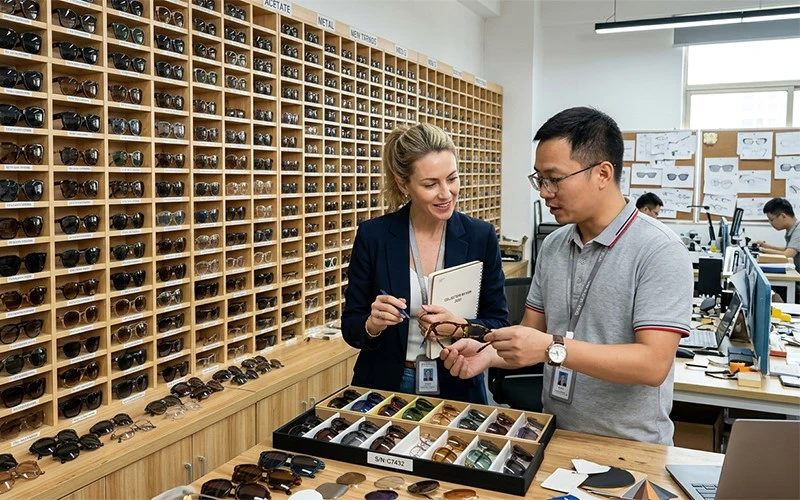
Shared styles follow a simple logic. Factories develop continuously and maintain a library of proven models. You select from that library, add your logo and packaging, and usually adjust colours or lenses. Moulds already exist and production lines are already set up for these models, so sampling takes days rather than months. Entry cost and first-order risk stay low. For a younger European label with a limited budget and a selling season to catch, this is often the rational starting point.
The trade-off is equally plain: the model is not exclusive. The same frame can appear in several brands' catalogues at the same time. You may sell it in Germany while another sunglasses manufacturer lists it in Spain at a lower price. Offline channels with territorial coverage can sometimes live with this. Online brands find it harder, because identical product photos make price comparison immediate, and comparison almost always ends at the cheapest listing.
Buyout Styles: Paying for Exclusivity
Buyouts take one of two forms. The first is a model buyout: you pay to take an existing model off the factory's open library, after which it becomes exclusive to you. The second is commissioned development: you fund a new design, and the drawings and tooling belong to you from the start. The first route covers the model itself plus the development work already sunk into it. The second covers the full path from design to tooling. Pricing varies widely with construction and process complexity. Most factories do not publish a rate card; figures are negotiated case by case, and the buyout fee for a clean acetate frame will differ sharply from one with a complex metal bridge or custom hinge.
One distinction buyers regularly miss: an exclusive licence and a full ownership buyout are two different things. An exclusive licence grants you sole supply within a defined scope while the factory retains the design. A full buyout transfers the design and tooling rights to you. Mixing up the two is a common source of disputes, and the contract must state which one you are paying for.
Exclusivity only exists if it is written into the contract. The most frequent gaps we see in draft agreements:
- Territory and duration defined loosely or not at all
- Derivative styles left outside the exclusive scope, so the factory can sell a slightly modified version of your model
- No overproduction limit, so the factory can run extra units "to cover yield"
- No disposal rule for leftover stock after the agreement ends
If surplus units leak into discount channels or parallel markets, the exclusivity you paid for stops working on the shelf. Disposal rules for leftover stock belong in the same agreement, not in a separate discussion.
Shared Styles vs Buyout Styles: Comparison
|
Dimension |
Shared styles (non-buyout) |
Buyout styles |
|---|---|---|
|
Design source |
Factory's existing model library |
Bought-out model or commissioned development |
|
Exclusivity |
None; same model available to others |
Yes, within the contract's defined scope |
|
Development cycle |
Short: select and adjust |
Longer, depending on depth of development |
|
Entry barrier |
Relatively low |
Higher; negotiated against exclusivity scope |
|
Best suited for |
Early testing, line extension |
Brands with budget and a clear differentiation strategy |
|
Main risk |
Style collision, weaker pricing power |
Gaps in exclusivity clauses, stock leakage |
The Middle Ground: Differentiating on Shared Styles
Between full buyout and pure sharing there is a workable intermediate layer. On shared models you can still secure exclusive colour stories, lens combinations, and packaging systems. The frame itself may be shared, yet your colour range and retail presentation stay distinct on the shelf.
Many factories also accept territorial exclusivity: the model stays available globally, but within one country, region, or channel the factory supplies only you. The cost is usually well below a full buyout, and for a brand focused on a limited set of markets this is often enough. We see this most often with DACH-region optical chains and with brands that sell through one national marketplace.
The most common sequence looks like this: test with shared styles first, then buy out once sales data arrives. A shared model lets you validate which colourways actually move before you commit capital. Once the numbers are clear, buyout investment goes to styles already proven to sell. This is a more controlled approach than buying out three or four untested designs on day one, and it is how most of the European brands we work with structure their first two seasons.
Territorial exclusivity is where many sunglasses supplier partnerships get creative, and also where sloppy drafting does the most damage. A factory can continue selling the same frame worldwide while stepping out of, for example, the DACH optical channel for your brand alone. For this to work, the clause must define the channel as precisely as the territory: whether "optical" includes online optical retailers shipping into the region, whether it covers marketplaces, and what happens to any existing account the factory already serves there. Existing-account carve-outs are normal and fair; the key is to list them explicitly, so the exclusive territory you pay for matches the one you actually receive.
Three Rules for Negotiating Exclusivity
Rule 1: define the model before comparing prices. A shared-style quotation and a buyout quotation placed side by side are not comparable. Lock the exclusivity scope first, then price.
Rule 2: put the scope in the contract before placing bulk orders. Territory, duration, derivative styles, and remedies for breach, item by item. Verbal assurance at the sampling stage has no value at reorder stage.
Rule 3: overproduction limits and leftover-stock control go in the same document. Treating them as something to discuss later is how leaked stock ends up in discount channels under another brand's label.
Frequently Asked Questions
Can a sunglasses factory sell the same frame to two brands at once?
Yes. Unless the model is bought out or covered by an exclusivity clause, a factory is free to sell the same frame to any number of brands. Different logos, colours, and packaging do not change the underlying frame.
What is the difference between an exclusive licence and a buyout?
An exclusive licence grants you sole supply of a model within a defined territory, channel, and period; the factory keeps the design. A buyout transfers ownership of the design and tooling to you. The licence is cheaper; the buyout is permanent.
How long does buyout development take?
Buying out an existing model is fast: samples within two to three weeks once terms are settled. Commissioned development from scratch typically takes four to eight months including tooling, sampling rounds, and testing, depending on construction complexity.
What should happen to leftover stock when an exclusivity agreement ends?
The agreement should say so. Common arrangements include a final sell-off window within the defined territory, destruction with documented proof, or buy-back at an agreed rate. Silence on this point is the main way exclusivity leaks.
Is territorial exclusivity worth it for a small brand?
For a brand selling into one or two markets, often yes. It costs far less than a full buyout and removes direct competition in the channels that matter to you, while the factory keeps the freedom to sell elsewhere.
How We Handle Both Models
We run both tracks: an open model library for shared-style selection, plus commissioned development and model buyouts, with exclusivity enforced as contracted. Our sampling and QC process is arranged to each order's specifications and the destination market's testing requirements.
We are a Shenzhen-based eyewear factory with nearly twenty years in OEM and ODM work across sunglasses, optical frames, and blue-light glasses. Typical MOQ is 300 pairs per style for custom orders; shared models on our sunglasses line remain available year-round. If you are weighing shared styles against a buyout, you can reach us through the OEM/ODM service channel - most workable partnerships start with a frank conversation about which model fits your stage.