


October is when European retailers lock in eyewear for spring/summer 2027, and the brief moving across desks this season has a clear shape. Much of it traces back to one document: the Sunglasses 2026 Retail Buyer's Guide, published by Boardsport SOURCE in June and still the most-quoted reference on the retail side. We read buyer guides the way we read order forecasts - for where the money will land. Three signals stand out this season.
The first is versatility, and it leads by a wide margin. "Sports eyewear has moved beyond just athletes and has become an everyday staple for a broader audience," Sofia Helmstrand Mohamoud of Swedish brand CHPO told the guide. Retailers report their best sell-through in what the trade calls the active lifestyle segment - eyewear worn for the workout and kept on for everything after. Aphex brand manager Casper Holtzapfel compressed the buyer psychology into one line: eyewear that "feels technical enough for active use, but looks clean enough for everyday wear." A pure race wrap with its vented foam gasket has turned into a niche product. The frame that moves volume now works the whole day.

The second signal sits at the baseline. Polarization, impact resistance and UV protection arrive standard now; buyers assume them, and serious factories deliver them. TR90 nylon leads on material because it is light, flexible and survives a backpack. Differentiation has moved one level up: a changeable look, a repairable structure, or a frame that crosses into fashion.
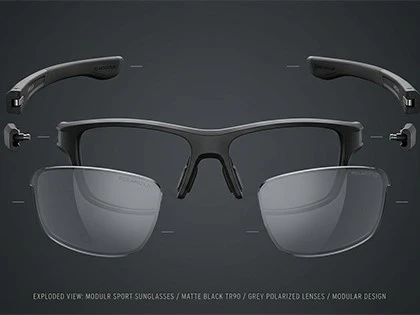
Repairability is where retail language is shifting fastest. Black Flys now runs a repair and spare parts service beside its regular line, and the guide's sustainability section keeps returning to durability - buy once, keep it long - alongside recycled and FSC-certified packaging. Factories have sold swappable temples and interchangeable lenses for years. Retail has caught up with the idea, which makes this the cheapest upgrade in the category: one front, several temple and lens combinations, fewer molds, faster reorders.
Shield and wrap shapes keep their shelf space - every brand in the guide still lists a large shield - and next to them a slimmer, more fashion-oriented shield keeps gaining space each season. A buyer covering the full shelf needs both. Factories that can cut a slim shield on the same lens geometry as a performance wrap save real development weeks.
The numbers reward this direction. Mordor Intelligence puts the global sports sunglasses market at USD 5.14 billion for 2026, growing 5.21% a year to reach USD 6.63 billion by 2031. Growth at that pace rarely comes from racers replacing gear. It comes from ordinary buyers wearing sport frames on ordinary days - the exact behavior the buyer's guide describes.
For a private label program, four things are worth fixing with your factory this quarter:
- One front, multiple options. A single frame platform with swappable temples and lenses covers running, riding and street use with one tooling investment.
- Match the lens to the use. Polarized TAC for street and driving; impact-rated PC or TR90 for run and ride.
- Design for daily wear, then torture-test for sport. Sample it on a face before it ever sees a bike.
- Ask how the swap system ages. A clip that loosens after three months of sweat ends a reorder.
At Leeyewear, our modular sport sunglasses run interchangeable temples and interchangeable polarized TAC lenses. The swap takes seconds, and the fit holds through a ride. If you are building a sport lifestyle line for next season, send us your reference styles and the activities you want to cover. We will come back with a frame platform spec'd for several looks from day one.
Sources
Boardsport SOURCE - Sunglasses 2026 Retail Buyer's Guide, Rocio Enriquez, June 2026
Mordor Intelligence - Sports Sunglasses Market - Growth, Trends, and Forecast (2026–2031)