


Acetate Eyewear Sourcing Guide: What Brand Buyers Must Know Before Tooling
By Cedric | Factory Sourcing Consultant, 12 Years in Shenzhen
Last Updated: September 2026.

I've watched brand buyers burn six months and twenty thousand dollars on acetate frames that looked perfect in the sample, then fell apart in QC. Usually because nobody told them that the sheet they picked in February determined the failure they found in August.
This isn't a design inspiration post. It's a checklist of what actually matters when you're sourcing custom acetate eyewear or running a private label line - written by someone who still has factory dust on his shoes from last week's visit. If you want pretty pictures of Italian boutique frames, go follow an Instagram account. If you want to know why your last shipment had a 12% return rate, keep reading.
1. Sheet Thickness: The Look-Weight Trade-off
Standard acetate sheet runs 2 mm to 7 mm. That range isn't arbitrary; it's a fork in the road.
Thick stock (5–7 mm) gives you the bold, sculptural look that vintage revival frames demand. Deep lens grooves, chunky temples, serious heft. The downside is weight. A thick full-rim frame can hit over 30 grams before lenses. Fine for fashion sunglasses that sit on a face for two hours at brunch. Miserable for all-day optical wear behind a desk.
Thin stock (2–4 mm) is the lightweight route, but thin doesn't mean cheap. Low-grade acetate at 2.5 mm will flex and warp after a month of wear; high-density sheet at the same thickness holds its shape because the molecular packing is tighter. The real trick experienced factories use is differential cutting: 4.5 mm on the front face for visual presence, tapered down to 2.7 mm on the sidewall. The front looks substantial head-on, but the frame drops into a manageable weight class. I've seen this cut executed well at 18 grams for the front alone. Pair it with titanium temples and you're competing with metal frames on comfort while keeping acetate's color depth.
You can't have all three - thickness, lightness, and bulletproof durability. Pick two. If your brand DNA is bold and retro, commit to 5–7 mm and engineer comfort through temple design and nose pad geometry. If you're chasing the daily optical market, 2–4 mm with differential cutting is your sweet spot. Lead with your priority when you talk specs, not a random number you saw on a competitor's website.

2. Lamination: Block, Extruded, or Layered?
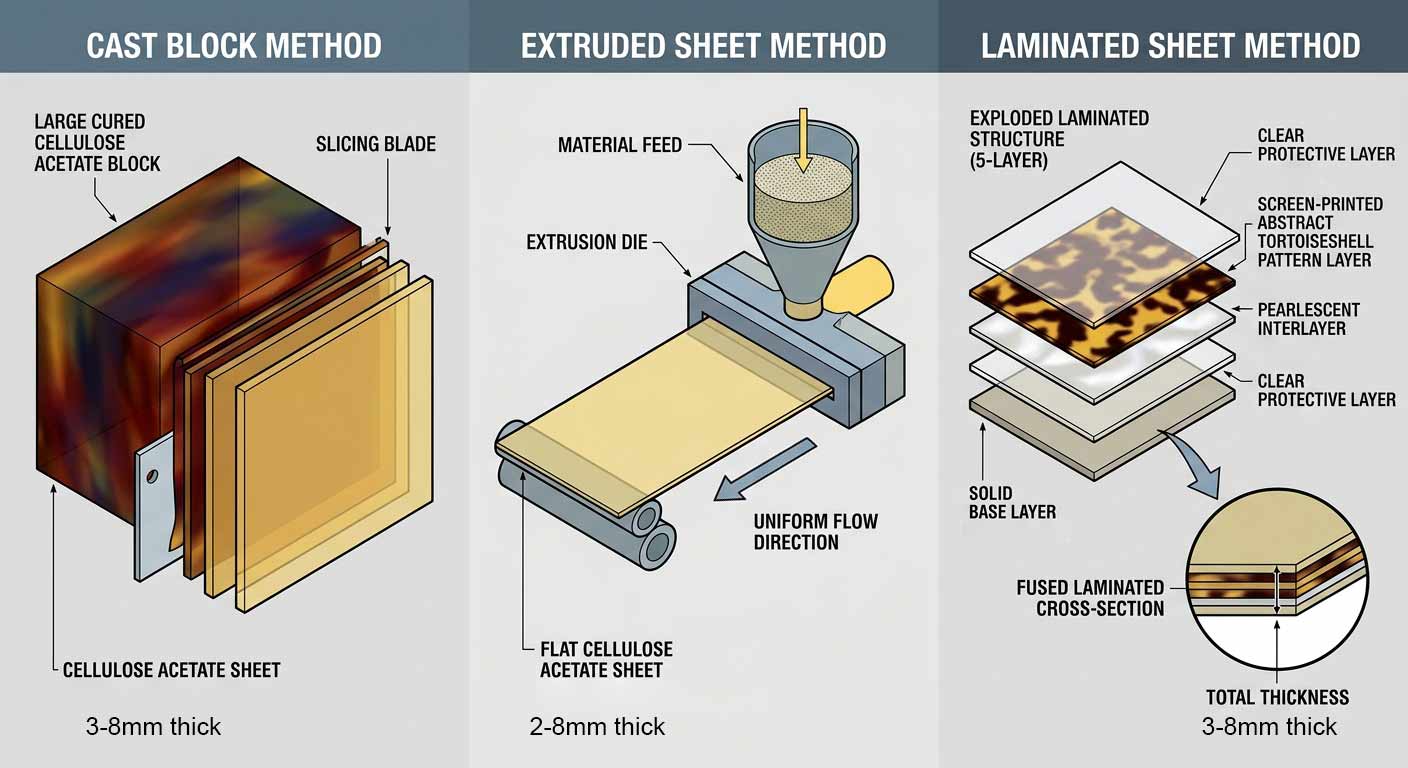
Acetate patterns live inside the sheet, not on it. But not all sheets are born the same way, and the method determines what you can and can't design.
Cast (block) acetate is the old-school method. Raw cellulose acetate pellets are mixed with colorants, cast into large blocks, then cured and sliced into sheets. This is how Mazzucchelli built its name in Italy, and it's still the gold standard for depth. The color saturation is rich, the pattern has real dimension, and no two sheets are identical. The downside is cost and lead time.
Extruded acetate is the industrial route. The material is melted and pushed through a flat die in a continuous sheet. It's cheaper, more consistent from meter to meter, and flatter. For solid colors and simple patterns at volume, it works. For complex depth and internal shimmer, it falls flat because the color mixing happens under shear stress, which blurs fine detail.
Laminated sheet is where patterns get interesting for mid-to-high tier work. Factories slice sheets down to 0.2–0.5 mm, screen-print designs onto those slices, then fuse them back into a stack under controlled heat and pressure. The pattern sits at a precise depth. Pearlescent layers or metal foils can be sandwiched between sheets with different refractive indices to create that 3D shimmer you see on premium frames. The risk here is delamination if the bonding cycle is rushed.
The number that separates a good factory from a risky one is peel resistance. Tested per ASTM D903 (180° peel angle, 300 mm/min crosshead speed), reliable laminates should clear 5 N/cm. I've seen samples that looked gorgeous in the showroom test at 2 N/cm. They delaminate at the temple bend within a season. Ask for the test report with the actual test parameters written out.
3. Surface Work: Where Margin Lives or Dies
Lamination decides what's inside. Surface finishing decides what the buyer feels in their hand and how your margin survives the quarter.
| Finish | Method | Cost Tier | Notes |
|---|---|---|---|
| Hand polish | Progressive sanding + buffing wheels | Medium-High | Non-negotiable for premium lines. |
| Laser engraving | CNC-guided laser | Low | Best ROI for logos and micro-patterns. |
| CNC carving / embossing | Mechanical cut or pressed die | Medium | Adds tooling cost; needs MOQ to justify setup. |
| HD print + enamel | UV-cured ink + clear coat | Medium | Good for fashion-forward seasonal details. |
| Heat-pressed 3D texture | Heated sheet pressed into textured die | High | Low yield, high scrap. Reserve for flagship SKUs. |
Laser engraving a temple logo adds pennies per unit and looks crisp. Heat-pressed 3D texture adds dollars - and that's before you count the reject pile from misaligned dies or temperature variance. If you're running wholesale acetate frames at volume, stick to hand polish plus laser. Save the exotic finishes for your hero SKU where the retail margin can absorb the yield loss. I've watched young brands blow their entire COGS budget on a surface treatment that looked incredible in the sample room and terrible on the P&L. The sample room lies. The spreadsheet doesn't.
4. Pattern Control: The Consistency Problem
If metal frames sell on engineering, acetate frames sell on emotion. And emotion lives in the color.
Tortoiseshell - that amber-and-ink marbling - is still the reference point. But the palette has exploded: translucent smoke, gradient fades, watercolor washes, metallic flake. For buyers who want the name recognition, Italian supplier Mazzucchelli remains the benchmark for saturation and batch consistency. That said, don't ignore China's top-tier mills. Jinyu Plastic and Jimei New Materials have closed the gap significantly in the mid-to-high segment, and their minimums are often friendlier for emerging brands still testing market fit.
In order to control the quality, we use the reliable raw material.
Here's the problem: every sheet is unique. Pigments flow and settle differently during lamination. That charm for the end consumer - "my frame is one of a kind" - is a nightmare for QC if one unit looks like rich tortoise and the next looks like muddy water.
When you approve a color, approve a range, not a single point. Specify acceptable pattern density and explicitly ban large solid-color voids. For high-consistency collections, either contract a tight tolerance in writing or steer toward solids and uniform laminates where variation is minimal. If you can't handle the randomness, don't design around it. I tell every new client the same thing: pick your battles. Either embrace the variation and sell it as artisan character, or kill it with solid colors. Trying to split the difference is how you end up with a 20% return rate.
5. Hybrids: When One Material Isn't Enough
Pure acetate has limits. It's heavier than titanium. It gets brittle below 10°C. And you can only heat-adjust it so many times before the polymer chains fatigue and snap.
Acetate front + titanium temples is the most proven combo. You keep the color depth and pattern where the world sees it, and drop titanium on the temples for weight savings, corrosion resistance, and micro-adjustability. For optical frames worn eight hours a day, this hybrid is now standard in the mid-to-high market. It costs more to assemble because alignment is tighter, but the retail premium usually justifies it.
Acetate + carbon fiber pushes further. Carbon's strength-to-weight ratio lets you run temples almost impossibly thin and light. It's overkill for most fashion lines, but if your brand plays in performance eyewear or ultra-luxury, it's a legitimate differentiator that justifies a higher price bracket.
Acetate + stone inlay is where things get genuinely eccentric - and genuinely expensive. I had a European client once, a boutique label out of Berlin, who wanted hand-set natural stones inlaid into glossy black acetate temples. Not crystals. Not cubic zirconia. Actual stones with organic veining and irregular surfaces. The catch? You can't source two that match. Every piece had a different grain, a different catch of light, a different personality.
Most buyers would call that a defect. He called it the point. His customers were paying for the fact that no one else on the planet had the same temple pattern. It was bespoke eyewear in the truest sense - not customized sizing, but material singularity.
The reality? Yield was brutal. Setting irregular stones into acetate without cracking the surrounding material takes a steady hand and a lot of rejected frames. Labor cost per unit ran higher than the acetate and titanium combined. This is not a 5,000-unit Christmas SKU. This is a fifty-unit drop for clients who don't ask the price until they've already decided they want it. If your brand lives in that rare air, stone inlay is a real differentiator. If you're trying to scale, it's a trap dressed up as a feature.

Hybrids cost more and assemble slower. You need a factory that has built the jigs before, not one that's willing to try for the first time on your purchase order.
6. Hard Limits: What Acetate Won't Do
Knowing the boundaries saves more money than knowing the possibilities. I keep this list taped to my monitor.
- High prescriptions need care. A -6.00 D lens in a thin rim works if you use 1.74 high-index material and proper edge thinning. A -8.00 D lens in a chunky fashion frame gives you the "bottle-bottom" effect - thick edges protruding from the groove like a fishbowl. Either spec a wider rim profile or move the customer to a full-rim metal option.
- Cold makes it brittle. Below 10°C, acetate stiffens and loses impact resistance. If your market is Scandinavian winters or Canadian ski slopes, warn end-users or spec flexible metal cores in the temples.
- Weight floor. Even thin pure-acetate frames run 15–25 grams complete. Pure titanium sits at 8–12 grams. For weight-sensitive wearers, hybridize or switch materials entirely.
- Adjustment fatigue. You can heat-bend acetate, but every cycle weakens the polymer. Two adjustments max, then replace the frame.
- Transparency limits. Deep, opaque colors are acetate's strength. If your design relies on crystal-clear light transmission or backlight effects, test the sheet first. Dark laminates absorb light; they don't transmit it.
7. MOQ & Cost Reality
Let me save you the awkward email thread with your factory contact.
| Material Choice | Typical Frame MOQ | Sample Lead Time | Cost Impact vs. Standard Solid |
|---|---|---|---|
| Standard solid color | 300 pcs | 2–3 weeks | Baseline |
| Standard laminated pattern | 300 pcs | 2–3 weeks | +10–20% |
| Custom color (existing sheet line) | 300 pcs | 3–4 weeks | +20–30% |
| Custom sheet development | 500 kg sheet | 6–8 weeks | +40–60% |
| Metal lamination | 1,000 pcs | 6–8 weeks | +80–120% |
| Bio-acetate spec | 500 pcs | 3–4 weeks | +15–25% |
Custom sheet development is where young brands get burned. That 500 kg minimum sounds abstract until you realize it's roughly 3,000–4,000 frame fronts worth of material. If you're not absolutely sure you can move that volume in your first season, work within your factory's existing stock lines. The best factory relationships I've seen are built on pragmatism, not vanity projects that look good in a press release and terrible in a warehouse.
Frequently Asked Questions
What's the minimum thickness for durable acetate frames?
3 mm is the practical floor for daily optical wear. Below that, you need high-density stock and expert engineering to prevent warpage.
How is laminated acetate different from printed plastic?
Laminated acetate fuses colored layers under heat and pressure, so the pattern runs through the entire sheet. Injection-molded plastic relies on surface paint or internal pigment swirl, which lacks depth and durability.
What MOQ should I expect for custom acetate colors?
Using a factory's existing sheet catalog: typically 300 pieces. True custom sheet development requires 500 kg of raw material - about 3,000+ frame equivalents.
Is Mazzucchelli worth the premium over Chinese sheet?
For ultra-premium brands where heritage and story matter, yes. For most mid-tier and entry lines, top-tier Chinese suppliers deliver comparable performance at lower MOQ and price.
Can acetate frames handle high-prescription lenses?
Yes, with caveats. Prescriptions above -6.00 D need high-index lenses (1.67 or 1.74), smaller eye sizes, and wider rim profiles. Very high prescriptions are better suited to full-rim metal frames.
Turning these specs into a production line?
Our engineering team reviews frame designs for manufacturability before you commit to tooling.
►Contact us for a free DFM review