


How Is the Quality of Acetate Eyewear Checked?
by LEEYEWEAR
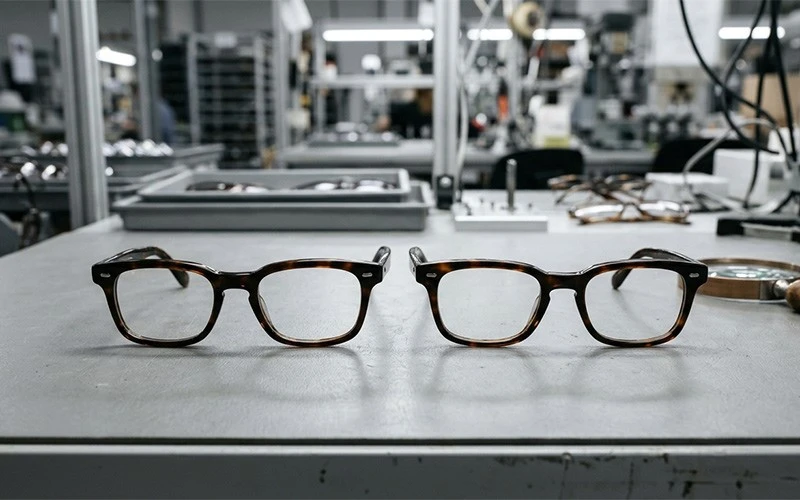
Our team has been in the eyewear industry for over 20 years. The question new buyers ask us most often is a simple one: why do two acetate eyewear frames that look exactly the same carry such different price tags?
Put them side by side. Same weight. Same shine. The hinges open and close smoothly on both. So where does the price gap come from?
The short answer: you are not comparing materials. You are comparing quality control systems.
Acetate eyewear frames depend on manual work more than any other frame category in the business. A cheap pair and an expensive pair may differ by only pennies in raw material cost, but the quality inspection behind them decides whether that frame lasts three months or three years on a customer's face.
This guide covers what I wish someone had told me when I started buying acetate frames: how to read the QC behind the price, what to inspect before shipment, and which certifications actually mean something.
Why Acetate Frames Are Harder to QC Than Other Materials
Start with the material itself, because it explains everything else.
Injection molded frames come out of a machine. Set the mold once, and every frame is virtually identical in size, wall thickness and surface finish. Quality control there is mostly about catching cosmetic defects and bad assembly. The variables are few.
TR90 frames live or die by the toughness of the material itself, so QC focuses on impact resistance and fatigue. Titanium frames come down to weld quality and plating thickness, both measurable with instruments against clear pass/fail standards.
Acetate is different. Its core processes, barrel tumbling, hand polishing, heat-inserted hinges and temple bending, all depend on human hands. The craftsman's touch, the humidity that day, even the age of the polishing compound in the drum will show up in the finished frame.
That creates three QC headaches you only get with acetate:
First, consistency is genuinely harder. In a batch of 1,000 acetate frames, you can see visible differences in polish brightness. The same batch of injection frames shows near-zero variation. That is why any factory serious about wholesale acetate frames checks color matching between front and temple on every single pair. Injection frames simply don't need that step.
Second, batch-to-batch color variation is normal. Even top-tier Italian Mazzucchelli acetate sheets show color differences between production runs, especially in tortoiseshell, amber and other mixed patterns. QC has to compare every frame under a standard light source. That is a cost other materials don't carry.
Third, acetate is sensitive to heat and moisture. Cellulose acetate contains hydroxyl groups (-OH), so it absorbs moisture from sweat and can swell, and it deforms under heat. QC cannot stop at "does it look good at the factory?" It has to answer "will it still look right after a summer of real wear?" That is why sweat resistance and high-temperature dimensional stability are non-negotiable tests for acetate.
In other words, acetate QC is not only about the finished frame. It is about whether the frame still looks and performs like new after real-world use. That is the core reason acetate costs more than injection, and why cutting corners on QC is so expensive in the long run.
The 5 Quality Problems That Get Acetate Frames Rejected
| Quality Problem | Root Cause | QC Step Factories Often Skip |
|---|---|---|
| Nickel release exceeding the limit | Hinges, screws or metal cores use nickel-containing alloys without compliant plating | Visual check only; no EN 16128 nickel release lab test |
| Sweat corrosion failure | Plating too thin or poor adhesion; coating peels after sweat exposure | No artificial sweat immersion test, or test duration too short |
| Deformation under heat | Internal stress not fully released; frame warps and lenses loosen | No 55°C ± 5°C high-temperature test, or no aging treatment after CNC cutting |
| Poor polish (dull spots, pits, flow marks) | Insufficient tumbling time; rushed hand buffing | Visual check under normal light only; no point-light reflection test |
| Hinge loosens or cracks after months | Acetate overheated during hinge insertion, causing local embrittlement and stress concentration at screw holes | No hinge open-close fatigue test; only smooth operation checked at shipment |
Test items per ISO 12870 and EN 16128; see References at the end of this article.
Pay attention to the last one. Hinge fatigue is what kills acetate frames quietly.
A frame can ship with perfectly smooth hinges and still fail within six months. When a technician heat-inserts a hinge, he softens the acetate locally with a hot air gun, presses in the hinge core and lets it cool. If the temperature runs too high or the heating lasts too long, the acetate turns brittle in that area. You cannot see it, and it passes every visual check. Months of daily opening and closing later, the hinge area cracks.
The only reliable way to catch this is a lab fatigue test running thousands of open-close cycles. Visual inspection cannot do it. And if you buy at the lower end of the market, that test probably never happened.
Three QC Tiers, Three Price Levels
Once you understand the failure risks, the pricing logic of an OEM eyewear manufacturer becomes clear. Factories generally operate at three QC levels, and each maps to a market position:
Tier 1: AQL Sampling (Volume / Entry Level)
The factory samples by AQL 2.5 under ISO 2859-1, the default standard for export orders. In plain English: inspectors pull a sample size based on your batch quantity, and the batch passes even with a defect rate around 2.5%. Do the math and you will see that 2 to 3 defective pairs out of every 100 can legitimately reach your customer.
Lab tests like hinge fatigue or nickel release at this tier are usually done once at product development, not repeated on every production batch.
This tier serves volume markets: promotions, fast fashion, entry-level retail. If you are building a private label eyewear line at the entry price point, this tier can work, but go in expecting a measurable return rate.
Tier 2: 100% Full Inspection (Quality / Mid-to-High End)
Every single pair goes through manual inspection: appearance, dimensions, symmetry, hinge function. Factories doing custom acetate eyewear and high-end acetate optical frames almost always insist on this tier. The labor cost is real, because a skilled inspector can only check a limited number of acetate frames per day when polish brightness and color matching require experienced judgment.
The math justifies it. If AQL sampling leaves you a 3 to 5% return rate, 100% inspection can push that below 0.5%. For a brand moving 100,000 pairs a year, cutting returns from 4% to 0.5% means roughly 3,500 fewer defective pairs in the field. Every returned pair costs round-trip shipping, re-inspection, rework and customer trust, and that is before you factor in brand reputation.
High-end brands don't run 100% inspection as a marketing gimmick. They run it because the numbers work.
Tier 3: Full Inspection + Batch Lab Testing (Premium / Designer Level)
On top of 100% inspection, every batch is sampled and sent to a third-party lab for the full performance suite: nickel release, sweat resistance, high-temperature dimensional stability and hinge fatigue. This is designer and luxury territory.
Here's what this actually costs. A single test like EN 16128 nickel release runs roughly $50–$150 per batch. A full performance suite - nickel release plus sweat corrosion, high-temp stability, hinge fatigue and flammability - lands somewhere between $500 and $1,200 per batch. SGS publishes a complete sunglasses test package starting at $1,163. Spread that across a 1,000-pair batch and you're looking at $0.50–$1.20 per pair in lab testing alone - before you count the 100% inspection labor, which typically runs 5–10% of the ex-factory price (roughly $0.50–$1.00 per pair at this tier).
Frames at this level generally carry an ex-factory price of $10–$20+ per pair. The QC cost becomes a meaningful percentage of that number, but when the retail price is several times the factory cost, it is easily covered - and more importantly, it's what keeps your return rate below 1% instead of 5%.
So when two acetate frames look identical but carry very different prices, remember where the gap sits. It is not in the material. It is in the QC level. What you are really buying is the probability that the frame doesn't fail on a customer's face.
Pre-Shipment Inspection: Your Last Line of Defense
So much for factory QC. Now let's talk about yours, because you should never rely on a factory's self-inspection report alone.
Factory QC is self-inspection, and self-inspection has a built-in conflict of interest: stricter inspection means higher rework cost and longer lead times. Every experienced buyer learns this rule sooner or later. Your first order with a new factory needs a pre-shipment inspection (PSI), ideally done by an independent third party.
The established names in third-party inspection are SGS, Bureau Veritas (BV) and Intertek. Their inspector visits the factory before the container is loaded, samples at your AQL level and checks the following:
- Appearance: scratches, pits, bubbles, polish defects, color consistency
- Dimensions: lens width and bridge distance under the boxing system, temple length, judged against ISO 12870 tolerances
- Function: hinge smoothness, screw tightness, even temple tension
- Packaging and labeling: logo placement, barcodes, CE/FDA marks, complete export documentation
- Shipping condition: carton strength, pack quantity, moisture protection
How do you choose the AQL level? Industry practice: critical defects (nickel release exceeding the limit, sharp edges) get AQL 0, zero tolerance.
Major defects (loose hinges, dimensional non-conformance, obvious scratches) get AQL 2.5. Minor defects (slight color variation, small blemishes) get AQL 4.0. If you sell a premium brand, tighten major defects to AQL 1.5.
The part most buyers get wrong is the contract. Don't accept vague wording like "quality must be qualified." Spell out four things:
- Which standard applies (ISO 12870 / EN 16128 / ANSI Z80.5)
- Which AQL level applies to each defect class
- How non-conforming batches are handled (rework, replacement or payment deduction)
- Who pays for third-party inspection (usually the factory, if the batch fails)
Write these terms clearly and the factory will take QC more seriously during production, because the cost of failure now lands on them.
CE, FDA and the Certifications That Actually Mean Something
One more thing buyers often overlook: international certifications are not just a piece of paper you pay for. They are external verification that a QC system actually works.
Different markets require different certifications and corresponding QC standards:
| Target Market | Core Certification / Standard | Key QC Items |
|---|---|---|
| European Union | CE + EN ISO 12870 + REACH | Nickel release ≤ 0.5 µg/cm²/week (EN 16128), sweat resistance, flammability, optical radiation resistance |
| United States | FDA registration (Class I medical device) + ANSI Z80.5 (ophthalmic) / ANSI Z80.3 (non-prescription sunglasses) | Biocompatibility, impact resistance, labeling compliance |
| Australia / NZ | AS/NZS 1067.1 | UV protection, impact resistance, labeling |
| Canada | Health Canada Medical Devices Regulations (Class I device) | Manufacturer/importer MDEL; safety and labeling requirements broadly aligned with US FDA |
Take the EU as an example. REACH (Annex XVII, Entry 27) sets the nickel release limit at 0.5 µg/cm²/week. Spectacle frames and acetate sunglasses are tested under EN 16128, the frame-specific method, which retains a 0.1 analytical correction factor on measured results. Other metal articles in prolonged skin contact fall under EN 1811, where, accounting for measurement uncertainty, a measured value at or below 0.88 µg/cm²/week is deemed compliant. No factory passes this by claiming "our hinges are nickel-free." It takes a report from an accredited third-party lab. And a factory that passes this test consistently has its raw material sourcing and plating process under control, which is itself the sign of a mature QC system.
So when you check whether a factory holds CE certified eyewear or FDA approved eyewear credentials, don't stop at the certificate on the wall. Check whether they have the ongoing QC capability to keep passing those tests. Certificates expire. QC systems take years to build.
Three Rules I Wish Every Buyer Knew Earlier
I'll close the main guide with three rules I learned the hard way. Each would have saved me real money when I was starting out:
Rule 1: Ask about QC level at the quotation stage, not after. When a quote arrives, ask directly: "Is your outgoing inspection AQL sampling or 100% full inspection? Are nickel release and sweat resistance tested on every batch, or only once at product development? Can you provide the test reports?" Ask these three questions and the reason behind any price gap becomes clear immediately.
Rule 2: Your first order with a new factory needs third-party PSI. Don't skip it because "the factory seems professional." The inspection cost is small relative to the order value, and that first inspection sets the quality baseline for your entire relationship with the factory. If the first order shows a high defect rate, you either tighten the QC terms in the contract or you find another factory.
Rule 3: Write nickel release, sweat resistance and hinge fatigue into your acceptance criteria. These are the three most frequent causes of acetate frame returns, and the three items most likely to pass at shipment yet fail in use. Put them in the contract, with rework or payment deduction as the consequence of non-conformance. The factory will then build these tests into its own production process, because failing them now costs money.
FAQ: Acetate Eyewear Frame Quality and Inspection
Q1: What AQL level should I use when buying acetate eyewear frames?
Industry practice is AQL 0 for critical defects (nickel release over the limit, sharp edges), AQL 2.5 for major defects (loose hinges, dimensional non-conformance, obvious scratches), and AQL 4.0 for minor defects (slight color variation, small blemishes). Premium brands often tighten major defects to AQL 1.5.
Q2: Do I really need third-party inspection if the factory already does its own QC?
yes - at least for your first order with a new factory.
Q3: Is Mazzucchelli acetate worth the premium?
For mid-to-high-end lines, usually yes. Mazzucchelli acetate offers more consistent color between batches, better polish response and more predictable aging, which lowers QC cost downstream. For promotional volume orders, mid-tier sheets combined with strict 100% inspection can be the better value.
Q4: What certifications do acetate sunglasses need for the EU and US?
For the EU: CE marking under EN ISO 12870 with REACH compliance, plus nickel release testing under EN 16128. For the US: FDA registration as a Class I medical device, and ANSI Z80.3 compliance for non-prescription sunglasses covering impact resistance and labeling.
Q5: How often should nickel release and sweat resistance be re-tested?
At minimum, once per material or supplier change. For premium lines, testing on every production batch is the safer practice. Entry-level factories often test only once at product development, which is exactly the gap to ask about at the quotation stage.
Q6: How do I verify an OEM eyewear manufacturer's QC claims?
Ask three questions at quotation: whether outgoing inspection is AQL sampling or 100% full inspection; whether lab tests run per batch or only once; and whether they can show recent third-party reports for nickel release, sweat resistance and hinge fatigue. Then confirm everything with a third-party pre-shipment inspection on your first order.
Final Thought
Back to the question I opened with: why do two acetate frames that look the same cost so differently?
The cheaper one was inspected for "does it look good when it ships?" The more expensive one was inspected for "will it still look good after two years of real wear?" One saves QC cost. The other invests in brand longevity.
For a buyer, understanding this QC logic is not about shaving a few cents off the unit price. It is about making the right call when you see a price gap, because what you are really buying is the probability that the frame doesn't fail.
And that probability is the entire value of a quality control system.
References
ISO 12870:2016, Ophthalmic optics - Spectacle frames - Requirements and test methods, International Organization for Standardization.
ISO 2859-1, Sampling procedures for inspection by attributes - Part 1: Sampling schemes indexed by acceptance quality limit (AQL) for lot-by-lot inspection, International Organization for Standardization.
EN 16128:2015, Ophthalmic optics - Reference method for the testing of spectacle frames and sunglasses for nickel release, European Committee for Standardization (CEN).