


Mordor Intelligence's 2026 sunglasses report puts polarized sunglasses at 81.02% of global revenue in 2025. The same report forecasts non-polarized lenses growing at a 6.68% CAGR through 2031, ahead of the overall sunglasses market at 6.18%. For a brand or retail chain building a private label program for 2027, the question is how to weight each segment.
Polarized Is the Baseline Spec for Functional Programs
For driving, fishing, cycling, and other outdoor categories, the conversation with our clients starts at polarized and rarely moves. In North America, Europe, and Australia, glare control is a default feature. Clients in these categories typically test samples against a windshield or the surface of water before approving a spec, and their retail buyers do the same at the counter. A non-polarized spec in this category tends to be read as a cost cut by the end customer, and it shows up in returns and complaints downstream.
Where Non-Polarized Is Winning
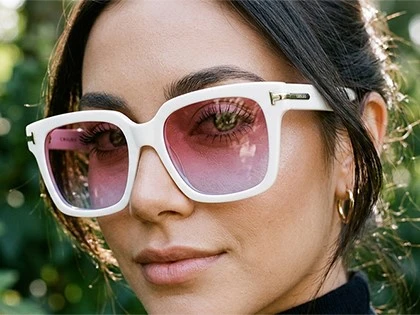
Most of that faster growth comes from fashion, for a practical reason. A polarized TAC lens is built on a PVA film that is stretched and dyed during production. Iodine or a dichroic dye is what makes the film filter horizontally polarized light, and the process leaves the film with a deep base tint. That is why most polarized sunglasses ship in smoke, grey, brown, or green bases. Mirror coatings and some gradient options exist, but light-tone and multi-color fashion colorways remain difficult on a polarized base.
A non-polarized lens can be dyed to order across a wide color range, so fashion brands and lens tinting houses default to it whenever color is the selling point.
Our own order book reflects this. Over the past two seasons, inquiries for dyed and gradient non-polarized lenses in nylon, PC, and CR-39 have risen from roughly 6% to 10% of our lens inquiries. Most come from brands whose primary channel is Instagram or TikTok. Their customers buy frames to match an outfit, so the lens has to photograph true to color, and the dark base of a polarized lens fights the colorway.
How to Split Your 2027 Assortment
Do not apply one lens policy across the whole line. Split by program type:
| Program type | Lens spec | Why |
|---|
| Driving / outdoor / sport | Polarized TAC, 0.75mm to 1.4mm | Functional buyers test for glare; non-polarized specs come back as returns |
| Fashion / city / social-media-first | Non-polarized dyed or gradient, CR-39 or nylon | Color matching with the frame drives the sale |
| Mixed private label line | Around 70/30 polarized to non-polarized | Close to our actual 2025 private label shipments |
The 70/30 split is a reference point, drawn from the private label programs we shipped in 2025. It keeps volume in polarized sunglasses while giving the fashion side room. Check it against your own channel data before committing.
The two lens types run on separate lines with separate cost structures, and a single program can carry both.
One constraint to plan around: a polarized TAC base limits your color story. Smoke, grey, brown, and a small group of hybrids make up the realistic palette. If the acetate frame is the product and the lens exists to complete the colorway, a polarized base will work against your design team.
Color Matching and Lead Time
For a dyed-lens fashion program, the fastest route is usually a stock lens match. Send us a reference: a competitor's lens photo, a Pantone number, or a physical sample. We check it against our in-house stock of nylon, PC, and CR-39 lens colors. A close match moves straight into production, with no color development wait and no custom tooling cost. If we do not stock a match, we will tell you and quote a custom dye run with its own lead time.
This keeps the inventory side flexible. A broad stock of lens colors across three materials lets buyers match a color from stock and move into production, without tying up capital in custom lens inventory or in colors the market rejects later.
Frequently Asked Questions
Are polarized sunglasses worth it for a fashion line?
For driving and outdoor lines, yes, polarized is the expected spec. For a fashion-first line, the dark polarized base restricts you to smoke, grey, brown, and green tones, and most light-tone or gradient colorways are difficult to achieve. Non-polarized is usually the better tool there.
What is the fastest way to get a specific lens color into production?
Send us a reference: a photo, a Pantone number, or a sample. If it matches our stock of nylon, PC, or CR-39 lenses, production can proceed without custom dye development. Custom runs are quoted separately with their own lead time.
Leeyewear
Leeyewear is an eyewear factory in Shenzhen, China. We produce private label acetate sunglasses, TR90 sport sunglasses, and titanium optical frames, OEM and ODM. Planning a dyed-lens fashion program for 2027? Send us your reference lens color. We will check stock and come back with a match or a quote.
Sources
Mordor Intelligence, Sunglasses Market Report 2026–2031: polarized at 81.02% of 2025 revenue; non-polarized forecast at 6.68% CAGR (2026–2031); overall market at 6.18% CAGR. Mordor Intelligence market summary via Research and Markets: growth drivers include fashion houses preferring color-accurate lenses, social media-driven purchasing, and Gen Z urban buyers.