


OEM vs ODM Sunglasses: How the Two Order Paths Differ
Written by Cedric, Leeyewear production team | Last updated: September 2026
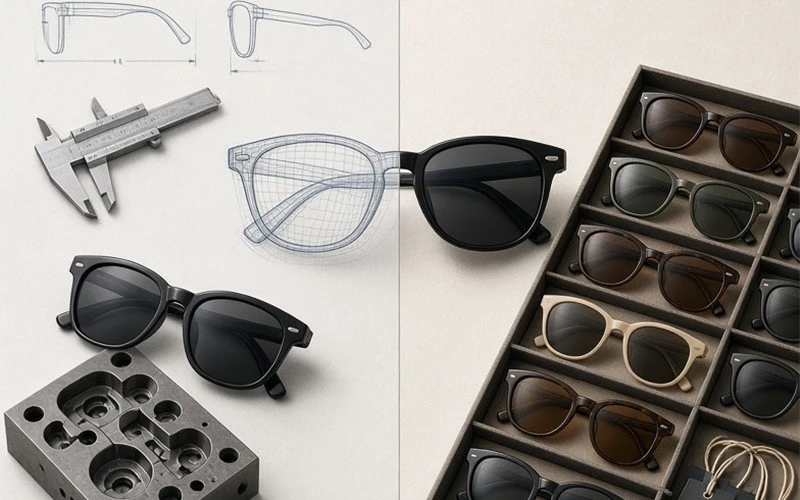
Summary: OEM and ODM are not two labels. They are two order paths. The practical test is who owns the design and the tooling. That single fact shapes the quote, who pays for molds, how sampling runs, and how long you wait. This guide compares both paths for OEM sunglasses and ODM sunglasses orders using production practice from several hundred eyewear orders at Leeyewear, set against standard supply-chain definitions of design ownership.
Buyers use "OEM" and "ODM" loosely. On a real order they describe different work: how the factory builds the price, who funds the mold, how samples move, and where time gets lost. The right question before you negotiate is not what the letters stand for. It is who owns this style.
The dividing line is design ownership and tooling, not the acronym
In standard manufacturing usage, OEM means the buyer supplies the design and the factory produces to that specification. ODM means the factory already designed the product and the buyer brands it, with limited changes. Intellectual property (IP) and mold ownership follow that split in most contracts, unless the parties agree otherwise.
Inside an eyewear order that usually looks like this:
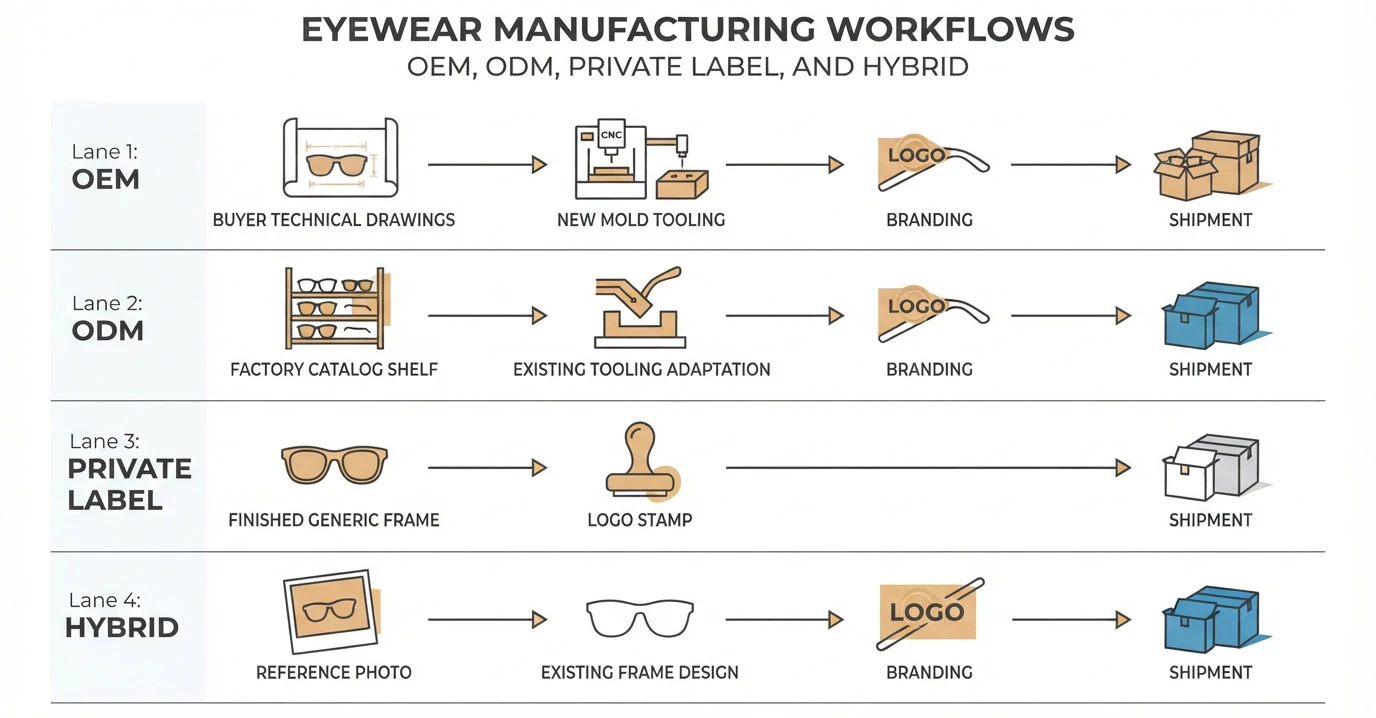
OEM: You bring drawings, a tech pack, or a fully specified sample. The factory tools and builds that style. Design ownership sits with you if the contract says so.
ODM: You choose from the factory's library. You change logo, color, lens, or packaging. The factory keeps the base design and the existing mold.
Private label: A narrower commercial use of an existing style - logo and packaging, little or no structural change. It is related to ODM, not identical to it.
Hybrid / modified ODM: You send a reference photo and the factory adapts a current structure. This is the grey zone. If the old mold still works, cost and lead time stay close to ODM. If the change needs new tooling or a new structural part, the job starts to behave like OEM.
In a meeting, the acronym matters less than two answers: who owns this style's IP, and who owns the mold. Put both in the contract.
OEM vs ODM sunglasses cost: how the quote is built
An OEM quote is built from scratch: material yield, tooling, sampling labor, line time, and scrap. Two or three days is a fast turnaround. First-order prices look high because development cost is still sitting in the number.
An ODM quote is faster because the style already has history. Material, labor, and loss rates are known. A morning inquiry can have a number by afternoon. The unit price looks better for a structural reason: design and mold cost were absorbed across earlier runs.
Once reorders are stable, many brands move the winning shape onto a private mold. That is a commercial choice, not proof that OEM always wins on margin. Ask whether an OEM-capable factory also keeps a ready-style library. That one question removes a lot of early development friction.
How sampling differs
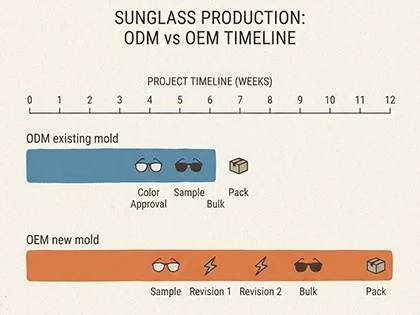
OEM sampling starts with drawings. Confirm the frame drawing and engineering sheet, cut or modify the mold, pull a first-article sample, revise, then issue a sales sample. Three to four weeks is possible on a simple injection style with few changes. Complex geometry, metal assemblies, or repeated redraws can take two months or more. A European buyer we worked with spent nearly a month on two rounds of nose-pad angle changes. That is normal on a new structure. Sample milestones belong in the purchase schedule before signing.
ODM sampling is shorter because the mold already exists. A color change and logo application can ship in about a week. Some buyers approve from a color card and logo position and go straight to bulk. If you are racing a retail date, this is the usual reason to start on a catalog style.
Sample fees follow the same split. OEM samples carry tooling or first-article cost. ODM samples mostly cover labor and freight, and are sometimes waived. The fee gap traces back to mold ownership.
Tooling: the clause that predicts reorders
OEM work usually cannot avoid tooling. Three common arrangements:
Buyout: The buyer pays the mold in full, owns it, and the factory stores it and must not run that tool for anyone else.
Amortization: Both sides agree a volume threshold - 5,000 pairs is a common talking point, not a universal rule - after which the fee is refunded or credited.
Factory-funded tooling: The buyer commits to a written reorder volume. This is rare with new accounts.
Clear tooling terms tend to travel with higher reorder rates. Buyers push a style they paid to tool. Factories gain a reserved production line. Waiving a one-time mold fee can be rational when the style has three to five years of demand behind it.
ODM barely opens this discussion. The molds are factory assets. You buy output from tools you do not own.
Typical first-cost ranges vary by process. Treat these as planning bands, not quotes:
| Process | Typical tooling / development note |
|---|---|
| Acetate, cut and finished | No injection mold; you pay handwork and sample labor |
| Metal | Jigs and small tools commonly in the low hundreds to about $1,000 |
| Injection plastic | New frame molds commonly run about $1,000–$3,000 for simple cavities; complex or multi-cavity sports-frame molds cost much more |
Always separate mold ownership, storage, transfer rights, and who owns later design changes. A mold sitting in a factory is not automatically your property.
Lead times, MOQs, and the usual traps
Lead time depends on material, change scope, and season. The ranges below are planning figures from confirmed details to FOB-ready goods, not promises.
| Path | Sampling | Bulk after approval | Common planning window |
|---|---|---|---|
| ODM / private label on an existing injection style | about 7–15 days | about 25–40 days from final color and logo approval | often 4–8 weeks |
| OEM on a simple new injection style | about 3–6 weeks if revisions stay limited | about 30–60 days | often 45–75 days, longer in peak season |
| New metal or complex structure | 4–8 weeks is common | 45–75 days is common | 10 weeks or more is not unusual |
| Handmade acetate OEM | about 2–4 weeks for a prototype; no steel frame mold involved | often around 3 months | hand-work calendar, kept separate from injection planning |
A true new sports frame with several sample rounds can take much longer than 75 days from first drawing to first shipment. Plan against the engineering the style still needs, not the best-case injection calendar. Acetate runs on a different clock because there is no shared injection tool to amortize.
MOQs vary by manufacturing process, not by acronym. Catalog and ODM colors can start lower. Custom sunglasses on a new injection or metal style typically start around a few hundred pairs per color or per style. Acetate can go lower for the same reason.
OEM trap: drawing approval and physical approval are different events. Round trips burn weeks. Lock one signed drawing pack and one signed physical sample before mass production.
ODM trap: catalog overlap. The same base can ship to several buyers. Two practical fixes: negotiate market or period exclusivity, or make a cheap structural change - hinge, nose pad, temple end - so the shared base is no longer identical. That is semi-exclusivity, not a patent.
Own tooling does not stop copying. It stops that factory from running your tool for someone else, if the contract says so. Design patents, a China-enforceable NNN, and controlled drawing release are what raise the cost of imitation.
Side-by-side comparison
| Factor | OEM | ODM / catalog | Private label |
|---|---|---|---|
| Who designs the frame | Buyer | Factory | Factory |
| Typical IP position | Buyer, if assigned in writing | Factory owns the base | Factory owns the base |
| Tooling | New or heavily modified | Existing | Existing |
| Upfront cash | Higher | Lower | Lowest |
| Customization | Shape, structure, materials | Color, logo, lens, small tweaks | Logo and packing |
| Exclusivity | Possible with mold ownership and contract | Low unless protected | Lowest |
| Speed to shelf | Slower | Faster | Fastest |
| Best first use | Funded brand with a design already worth defending | Unproven market or tight calendar | Fast test of a known shape |
The path most surviving private labels take
Most brands that last do not start on a full private mold. They pick one or two fast-moving catalog styles, test price and channel, then redevelop the winners and open private tools. Design capability grows in parallel. The cycle takes two years at the fast end and five at the slow end. Factory quality decides whether the handoff is clean.
Starting on OEM from order one works only when the drawings, budget, and patience for sample loops are already in place. Otherwise the sampling stage alone stalls the launch.
Which path fits this stage
Brands that are well funded, design-ready, and building a style they need to keep start OEM. Brands on a tight budget or entering an unproven market start ODM or private label, and put the money saved on tooling into marketing and distribution. The proven shapes convert to private molds later.
Neither path ranks above the other. Most brands run them in sequence rather than choosing one forever.
We run both. If you have drawings, send the pack and we will quote the tooling and sampling line by line. If you want to start from a library, send the target price, material, and launch date (contact us get catalog). We will separate time and cost by path. If the job does not fit, you still leave with a clearer spec.
FAQ
What is the difference between OEM and ODM sunglasses?
In an OEM order you supply the design - drawings, a tech pack, or a reference sample - and the factory produces to your specification; the IP and the mold can be yours under contract. In an ODM order the factory supplies a design from its catalog and you brand it with your logo, colors, and packaging; the base design and molds stay with the factory.
Who owns the mold in an OEM sunglasses order?
Whoever the contract says. Common arrangements: full buyout, amortization with refund or credit after an agreed volume, or factory-funded tooling in exchange for a written reorder commitment. Ownership, storage, transfer rights, and restrictions on running the tool for other buyers all belong in writing.
Can I put my logo on ODM sunglasses?
Yes. Logo application, color changes, lens options, and packaging are the standard scope of ODM customization, and a sample can ship in about a week on an existing mold. Structural changes such as hinges or nose pads move the job toward the OEM side.
What MOQ should I expect for custom sunglasses?
It varies by process. Catalog and ODM colors can start low; new injection or metal OEM styles typically start around a few hundred pairs per color or style; acetate can go lower because there is no shared injection tool to amortize. Confirm the MOQ by material, not by acronym.