


Think Through Your Order Structure Before You Contact a Sunglasses Manufacturer
By Rain, Sales Director at Leeyewear
From March to July, our inbox in Shenzhen gets about a dozen inquiries a day. Fewer than half are easy to quote. The difference is rarely politeness or budget. It is order structure.
Plenty of buyers open with "what's your price for sunglasses." Price matters. Without a structure under it, that question has no answer. Ten styles at 200 pairs each and one style at 5,000 pairs are different jobs - tooling, color changes, packing, and scheduling are not the same, so the quote should not be the same either.
Leeyewear has made sunglasses, optical frames, blue-light glasses, and reading glasses in Shenzhen for nearly twenty years. Buyers who settle the structure first usually get a tighter price, a more honest lead time, and goods they can actually sell. This piece is about that work, not a catalog.
What "order structure" actually means
Three decisions do most of the work:
How many styles. How many pairs per style, and how those pairs split by color. Who the goods sell to, and through which channel.
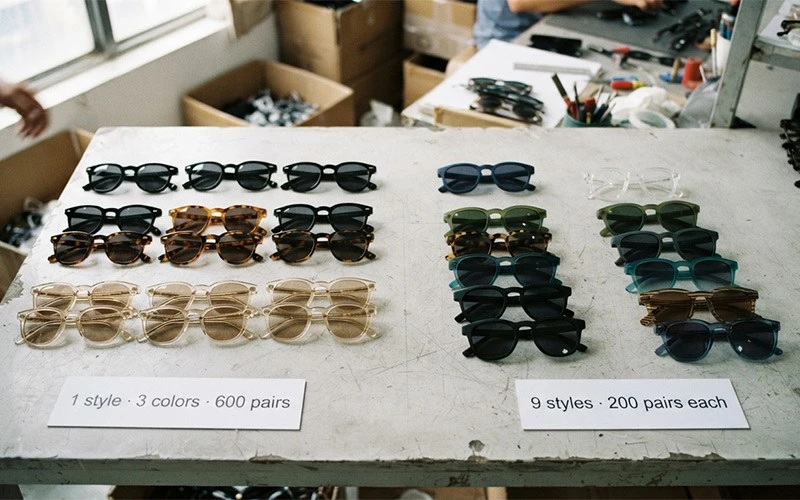
Those three points set price, lead time, packaging, and whether the order makes money. The worst first order I still remember came from a European buyer: nine styles, 200 pairs each, every color different. Sampling fees and color-change loss consumed about 30% of the goods value. He later cut the program to three styles with deeper color runs, doubled sellable stock on the same budget, and now reorders each season.
That is the whole argument in one case. Variety feels like a safer bet. On a thin first order, it usually is not.
Why a clear structure gets a tighter quote
Buyers and factories share one fear: the other side did not read. In buyer forums the complaint is "the seller never read my requirements - the offers do not match." The reverse is just as common. A one-line "what's your price" forces a padded range. Going high feels safer than going wrong. Three or four rounds then burn two weeks.
When a buyer needs a number quickly, a factory that knows its costs should still quote against standard specs and a stated sunglasses MOQ, with assumptions written in the open: quantity, material, packaging. The quote is a draft, not a guess. The buyer who can frame the order that way is doing the same job from the other side. Structure turns quoting into reconciliation.
Style count sets the production rhythm
A new style carries fixed cost: design, tooling, sampling, revisions, confirmation. That is why many China sunglasses manufacturers, including us, treat 300 pairs per style as a practical floor for most custom acetate and metal work on existing or lightly modified tooling. It is not a universal law. Ready stock can start much lower. Full OEM sunglasses with a new mold often need more. Injection PC/TR programs can sit higher still, because material changeover and barrel cleaning are expensive.
Below the floor, color-change loss and machine setup are hard to recover. If the whole budget is only 300 to 500 pairs, be blunt with yourself: one or two styles, more colors on those styles. In European retail, one style in three colors usually outsells three styles in one color each. Retail lives on collection merchandising. Wholesale lives on reorder speed.
Too many styles at thin volume forces the plant to cut separate line time. Lead time then fragments no matter how hard anyone pushes.
Match the structure to who you are
The same email can come from a middleman, a trading company, or a brand buyer. They should not send the same brief.
A middleman needs resale margin and steady delivery - fewer styles, volume concentrated enough to reorder. A trading company runs on cash turn; its structure follows the downstream PO. An end brand cares about same-style, multi-color merchandising and whether the factory can repeat the run next season.
Decide which of those you are before you talk to a factory. Copy someone else's structure and every quote will be wrong for you.
The sales channel changes the spec
E-commerce / private label: SKU structure first. Four colors of one style beat four styles of one color. Inner packs must survive parcel handling; the export master carton is a separate spec. For sea or multi-parcel outbound, a 5-ply master carton is a sensible floor. Amazon-bound goods also need carton marks, barcodes, and moisture protection that a boutique retailer may not ask for.
Offline chains: Inspection standards and dates are hard constraints. Vessel date, warehouse date, and shelf date lock in sequence. A late carton is not "a few days late"; it misses the planogram.
Gift and corporate: Packaging often costs more attention than the frame. The buyer is paying for something presentable. Quotes on these orders usually show a longer packaging line. That is the work, not padding.
One budget, two structures
Take a first-order budget of about 1,800 pairs. The factory sees two different jobs.
|
Scattered first order |
Tight first order |
|
|---|---|---|
|
Styles |
9 |
3 |
|
Pairs per style |
200 |
600 |
|
Colors per style |
4–5 thin colors |
3 deeper colors |
|
What you pay extra for |
Sampling, color changes, separate line setups |
Almost none of that |
|
What you can reorder |
Almost nothing at depth |
The two colors that sold |
|
Typical result |
High unit cost, broken lead time, leftover SKUs |
Lower waste, cleaner ship date, a second PO |
The left column looks like a collection. The right column is a collection the factory can build and you can restock.
What to send in the first inquiry
Six items are enough for an executable quote:
- Style count
- Quantity and color split per style
- Material direction (acetate, metal, TR90, PC, mixed)
- Target market
- Target delivery date
- Packaging requirements
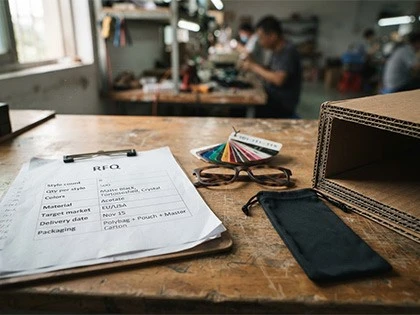
Those six map onto the usual buyer-forum checklist: target price, MOQ, samples, payment, logistics. With them on the page, a responsible plant can return a working quote the same day. Missing any two of them, the number you get is a range with water in it.You do not need a finished tech pack on day one. You do need to stop asking for "a price for sunglasses" as if sunglasses were one SKU.
Copy-and-send template
Styles: 3
Qty / colors:
Style A - 600 pairs (black 250 / tortoise 200 / champagne 150)
Style B - 600 pairs (black 300 / brown 300)
Style C - 600 pairs (one color for test)
Material: acetate frames, TAC lenses, UV400
Market: EU retail + own webshop
Need goods in warehouse by: 15 May
Packing: pouch + printed box; 5-ply export carton; carton marks attached
Assumptions we can live with: [FOB Shenzhen / your port]
March to July is peak ordering for European summer stock. Sea freight from South China to Europe commonly adds 25–40 days, not counting booking and customs. Chinese New Year and the August–October holiday ship rush cut available slots as well. Peak-season capacity is finite. The clearer brief gets the slot first. That is production planning, not a hidden rule.
How to read a factory before you compare prices
Itemized quotes help. Material, labor, packaging, and freight on separate lines show the plant can see its own costs. Freight is often quoted later on FOB terms; the useful test is whether packaging and frame are not mashed into one unexplained number.
A factory that flags a bad split is worth more than one that agrees with everything. If you send nine styles at 200 pairs, and nobody says the color changes will hurt you, they are not protecting the order.
Ask for one or two reorder relationships that have lasted three years or more. You are not collecting trophies. You are checking that the plant has survived a second and third season with the same customer.
Check those points before you rank prices. The sequence matters.
Also match scale. A 300-pair OEM order dropped on a plant built for millions of pairs a year sits at the bottom of the queue. A shop that lives on small-batch turnaround will treat the same order as work. "Big factory" is not automatically the safer buy.
Questions buyers ask most
Does a clear structure really change the price?
There is no fixed number. A clear order leaves less room to pad for uncertainty. On the same batch, the gap between a precise inquiry and a vague one often runs five percentage points or more in our experience. Treat that as an observation, not a formula.
Should a small buyer approach a large plant?
Yes, if the plant actually runs small programs. If it does not, you will wait. The right-sized partner treats 300 pairs as business.
Do I need an on-site audit on a first order?
Large programs, yes. For a 300-pair first run, a video walkthrough plus a third-party report is usually enough. Any established factory accepts that sequence. One that refuses it hard is giving you information for free.
Send the structure, then ask for the price
Think the order through before the first email. You will get a cleaner number from whichever factory you choose.Send Leeyewear the six items. We will quote against that structure. Where the split does not make sense for OEM sunglasses at this volume, we will say so before you pay for samples.