


What Is the MOQ for Custom Sunglasses?
A Factory Floor Guide for Small Brands, Amazon Sellers, and Wholesale Buyers

I've watched that exact exchange more times than I can count. Twenty-plus years on the floor in Shenzhen. Just last Tuesday, a seller from Ohio sent me the same message. "MOQ 3,000?" He ghosted us for two days. Then he came back and asked why.
Custom sunglasses MOQ isn't a hard wall. It's the opening move in a conversation. You just need to know what pushes the number up before you start talking.
When we say MOQ on the floor, we usually mean per style. But buyers sometimes think it's per order. Or per logo print. That mismatch alone kills half the deals before they start. A logo on an existing frame is one conversation. A brand-new mold is another. Below are the numbers we actually quote when the details are clear. No theory. Just what comes out of our weekly production meetings.
Why Custom Sunglasses MOQ Is the First Question Buyers Ask (And Why Factories Hate Answering It Blind)
Small brands and startup sellers live in quiet panic about minimums. They worry the factory will shut the door before the first sample even ships.
From our side of the table, quoting a bare number without knowing the scope feels like answering "how much is a car?" when nobody has said whether they want a hatchback or a truck.
Custom printed sunglasses minimum order can swing wildly depending on what "custom" actually covers. Frame mold work sits in one bucket. Logo print sits in another. Lens color or packaging lives in a third. Each has its own logic. And its own price tag.
Most factories also keep a quiet bit of flexibility they never put on the Alibaba page-often 20–40% room once the buyer stops guessing and actually knows what's pushing the number up. That wiggle room only shows up once you actually get into the details.
| Customization Type | Typical MOQ | Setup Cost | Best For | ||
|---|---|---|---|---|---|
| Frame (new mold) |
|
$2,000–$8,000+ mold | Established brands | ||
| Frame (open mold) | 300–500 pcs | None | First-time buyers | ||
| Lens (tint/gradient) | 300–600 pcs/color | Low | Mid-size orders | ||
| Lens (polarized) | 600–1,200 pcs | Medium | Premium lines | ||
| Logo (pad print) | 100–300 pcs | $30–$80/plate | Startups / Amazon | ||
| Logo (laser engrave) | 200–500 pcs | Medium | Metal frames | ||
| Logo (full-bleed) | 500+ pcs | High | Full custom | ||
| Packaging (pouch) | 500–1,000 pcs | Low | Standard branding | ||
| Packaging (folding box) | 1,000–2,000 pcs | Medium | Retail ready | ||
| Packaging (polybag) | 3,000–5,000 pcs | Low per unit | High volume |
The numbers below come from the production meetings we run week after week. They are the ranges we quote when the order details are clear.
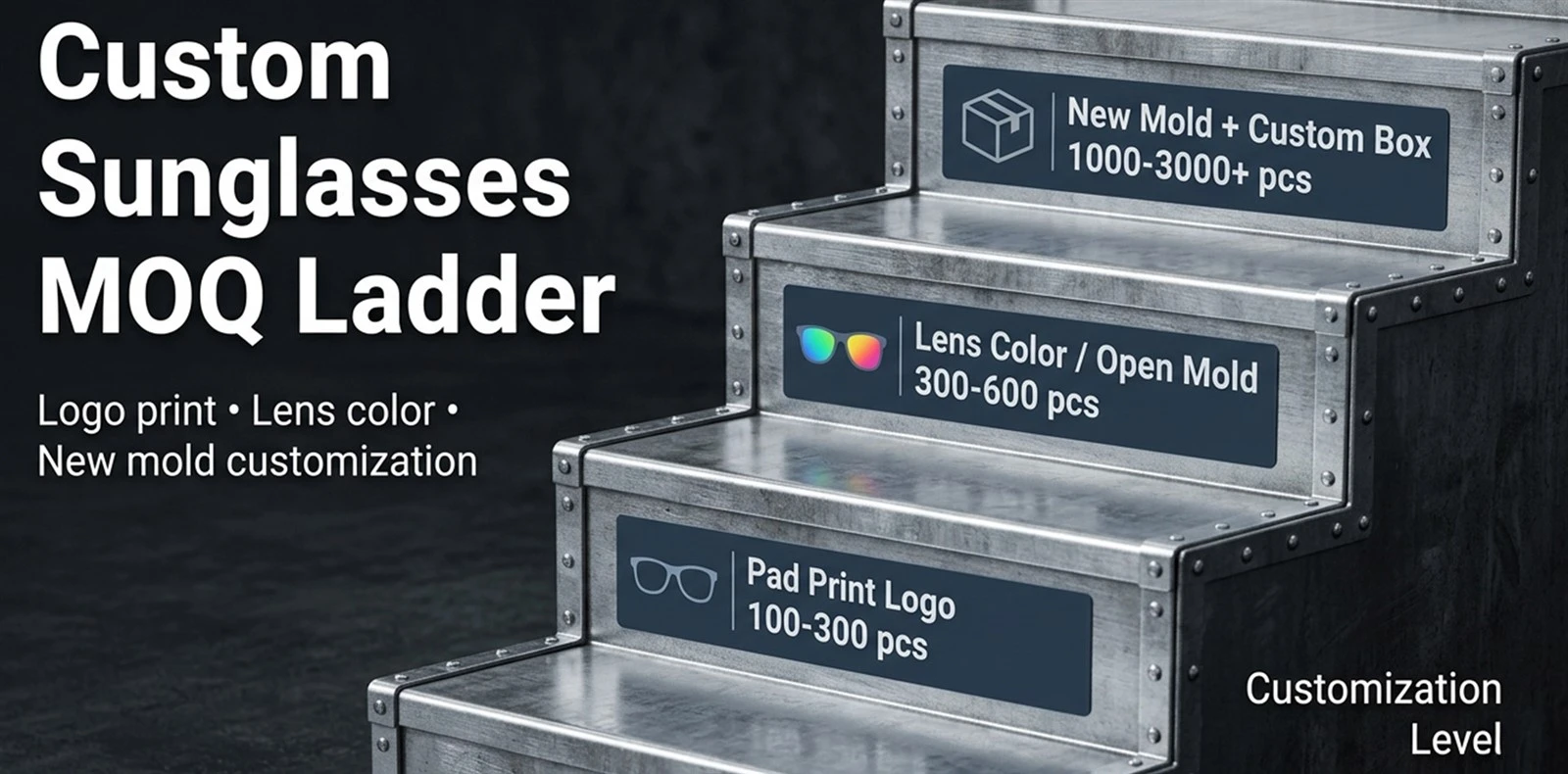
We think of it like a ladder internally. Logo-only sits at the bottom. Lens color and open molds sit in the middle. Full custom mold and packaging sit at the top. Keep that picture in your head.

If you're cutting a brand-new mold for a frame nobody's made before, we're almost always looking at 1,000 to 3,000 pieces per color way. Steel molds cost $2,000 to $8,000 for a standard plastic injection mold. Metal alloy frames use stamping dies or casting molds, which run on a different cost curve. Titanium tooling sits at the top of that range. And they take 30–45 days to cut. The factory has to amortize that spend.
Custom frame materials bring their own headaches. TR90, acetate, metal alloy-each material supplier has minimums, often 300–500 kg of raw material. Color matching to a Pantone on frames typically needs a separate batch run. So 1,000 pieces is standard. Some lines will accept 500 at a higher unit price. The fastest way around this? Use an open mold the factory already owns. You'll drop to 300–500 pieces instantly. No mold fee. No 45-day wait.
For lens tints, mirrors, or gradients, the floor is usually 300 to 600 pieces per color. Polarized lenses climb higher-600 to 1,200 pieces-because the film arrives in rolls and leftover material is hard to store.
For the promotional and fashion sunglass buyers we work with, prescription MOQs are usually a separate conversation. UV400 testing is charged per batch. CE marking documentation gets updated per production run, which also carries a small fee. Smaller runs push the per-unit testing cost up. Factories pass that through.
Most small brands start here because it's the cheapest way to get your name on something that looks custom without betting the farm.
Pad printing on stock frames is workable at 100–300 pieces. A few factories will go as low as 50 if the buyer accepts a steep per-unit premium. Laser engraving on metal temples or frames usually needs 200–500 pieces. Full-frame heat transfer or full-bleed printing starts around 500 pieces and up.
Each print color needs its own plate or screen, typically $30–$80. That setup fee is why a single-color logo carries a lower custom printed sunglasses minimum order than a multi-color design. We see this gap every week-single-color jobs move faster and cheaper.
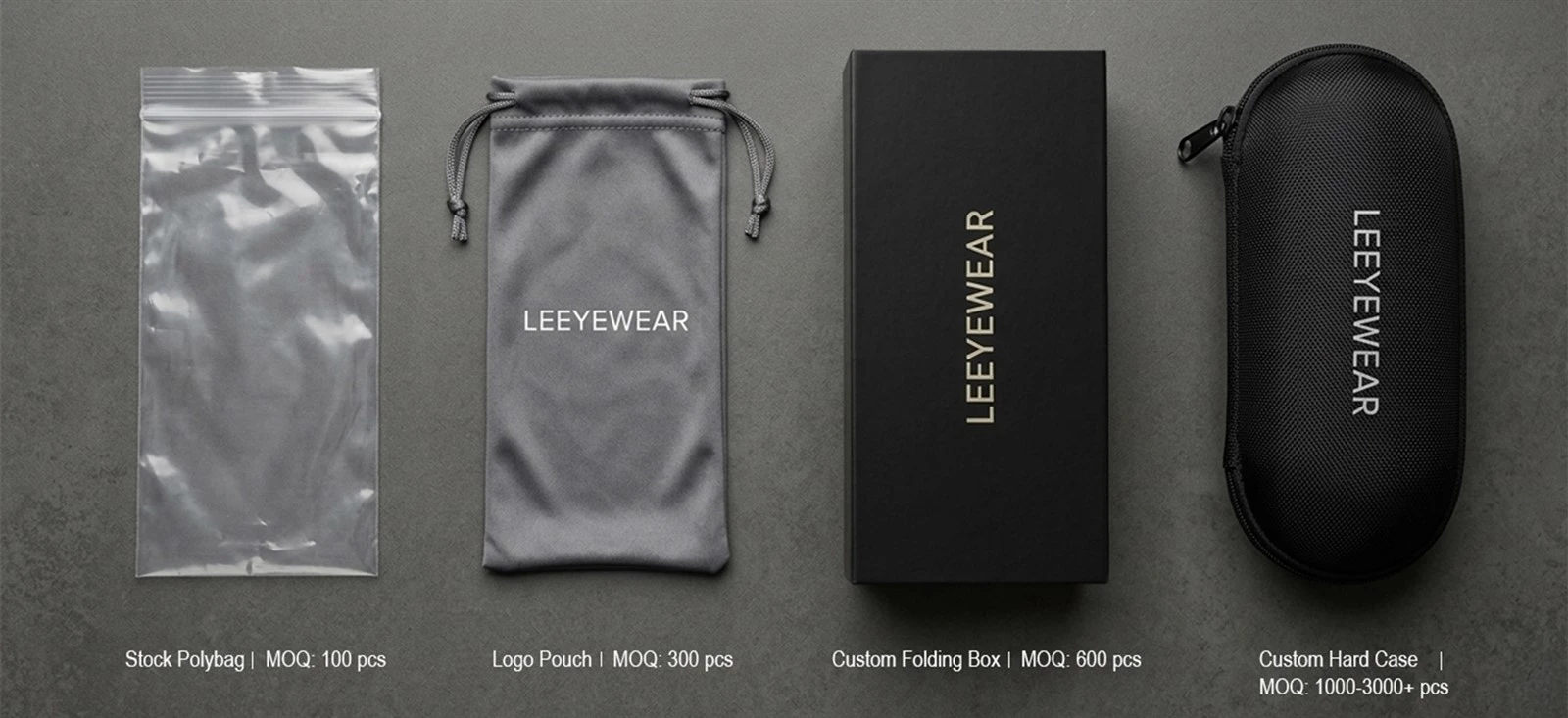
Custom logo microfiber pouches or bags often require 500–1,000 pieces. Folding boxes with logo print sit at 1,000–2,000 because paper suppliers have their own minimums. Hard cases can start around 500. Custom polybags with logo print are surprisingly high-3,000 to 5,000-because bag printers run roll-to-roll.
Here's a trick we tell first-timers: start with the factory's stock packaging and add a simple sticker logo on the first order. That keeps the packaging MOQ from doubling the whole project. It also keeps the overall custom sunglasses MOQ more manageable when you're still testing the water.

These are the calculations running in a sales manager's head while the quote is being typed. Some are obvious. Some aren't.
Mold Investment & Amortization:
A new mold means 30–45 days and anywhere from two to eight grand, depending on how complex the frame is. I've had buyers get frustrated when we quote a 2,000-piece minimum for a mold that cost us $4,500. But do the math. At 200 pieces, we're in the hole before the machine even warms up. No factory opens that for 200 pieces. Volume has to cover the risk.
Raw Material Supplier MOQ:
Acetate sheet suppliers sell by weight, not by frame count. Stock colors - black, tortoiseshell, crystal - run continuously, so factories can buy 10–50 kg with no issue.
Custom colors require a separate production run: the mixing chamber gets cleaned, pigments are formulated from scratch, and the extrusion line runs a full batch to stabilize the shade. Most domestic suppliers set the floor at 100–150 kg per custom color; imported sheet from Mazzucchelli or Takiron often demands 200 kg plus.
A finished acetate frame weighs 30–45 g, but CNC milling and hand-finishing waste 15–20 % of the material. That means 100 kg yields roughly 2,000 frames - far more than a small-batch launch needs.
Factory has two choices: buy the full minimum and store the excess, or scale your order to absorb it. Either way, the raw-material floor - not the factory - is what pushes acetate sunglasses MOQs to 300+ pieces per color.
Production Line Changeover Costs:
Switching an injection machine from black to other colors takes two, three hours. Plus you lose the first dozen shots while the color purges. I'd rather run 1,000 in one color than babysit five changeovers for 200 each. Most floor managers feel the same way. Five colors at 200 pieces each creates more pain than one color at 1,000 pieces.
Lens & Accessory Matching:
Hinges, nose pads, temple tips-each part has its own supplier minimum. Custom hardware quietly raises the floor. We learned this the hard way in early 2023. A buyer wanted a custom hinge on 400 pieces. The hinge supplier's minimum was 2,000. We ate the difference thinking we'd reuse them. We're still storing those hinges in our factory warehouse. That's why we're strict about hardware MOQ now. Lesson learned the expensive way.
Quality Control & Defect Rates:
We budget for anywhere from 3% to 10% depending on the frame complexity. Some days it's lower. Some batches it bites us harder. Factories pad the MOQ so they can replace units without restarting the whole line.
Seasonality & Factory Capacity:
March through May is the real madness. Everyone wants stock before summer. The molding room downstairs runs 24/7. You can smell the acetate from the hallway. That's how you know summer season is coming-by the heat and the smell, not the calendar.
January through March, before the rush, factories look for work. MOQ can drop 20–40%. By July we're often running reorders, which can be just as tight on capacity. Even larger brands wait, and minimums or lead times climb.
Relationship & Order History:
A first-time buyer often hears the higher number. By the third reorder the same factory will frequently cut the MOQ 30–50% because trust is already built. One buyer from Austin started at 300 pieces in spring 2024. He's now ordering 2,000 every quarter. We don't even talk about MOQ with him anymore.
| Factor | Impact on MOQ | What Buyers Can Do |
|---|---|---|
| Mold investment | 🔴 High | Use open molds |
| Raw material MOQ | 🟡 Medium | Consolidate colors |
| Line changeover | 🟡 Medium | Reduce SKUs |
| Custom hardware | 🟡 Medium | Use standard hinges |
| Defect buffer | 🟢 Low | Accept realistic mins |
| Seasonality | 🟡 Medium | Order Jan–Mar |
| Relationship | 🔴 High | Start small, reorder |
Small Batch Custom Sunglasses: Real Options for Startups and Low-Budget Sellers
Plenty of buyers come to us with only $3,000–$5,000 to spend and ask whether small batch custom sunglasses are even possible. The answer is yes, if the approach matches the budget.

Stock Frames + Custom Logo 100 to 300 pieces
This is where probably 60% of our first-time buyers start. One Amazon seller out of Austin did exactly this last spring. Three hundred pieces. One style. Black only. He sold through in six weeks and came back for a mold. That's the whole point.
You won't own the frame shape. But you'll own the data. And that's worth more than a mold at this stage. For many sellers, this is the smartest way to test the market without draining the account.
Semi-Custom / "Mix and Match"
We keep a few base frames on standby that let buyers pick lens color and temple-tip color without touching the mold. MOQ lands around 300 to 500. Not every factory advertises this. You have to ask directly. Sometimes twice.
Private Label Ready-to-Ship
Fifty to 100 pieces. Slap on a hangtag, call it yours. It's not really custom, but it gets you in the game. And it gets us used to working with you.
Group Buying / Consolidation
A few trading companies collect three or four small brands into one factory order. Each brand takes 200 pieces of its own color way while the factory hits an 800-piece total. Timing is shared. Control is split. But for buyers who need small batch custom sunglasses with true custom frames, this is one of the only doors open.
How to Negotiate Lower MOQ with a Sunglasses Factory (Tactics That Actually Work)?
These moves come from deals that closed. Not from theory.
Lead with the long-term picture. Factories care about lifetime value. A simple line-"this is the test run; target is 10k pieces a year if quality holds"-changes the conversation. Even a rough Amazon projection helps.
Offer to pay the full mold cost upfront, then negotiate credit on later orders. Once the factory risk drops near zero, low MOQ on the first run becomes easier. Smart buyers ask for the mold fee to be credited back after 5,000 pieces.
Here's one that sounds obvious but gets ignored: stop asking for six colors. Six at 300 each creates changeover headaches. Two at 900 is an easy yes
And if you can wait, say so. The factory can slot you between two big orders. Forty-five days instead of twenty-five. We call it filling the gaps.
For the first order, a trading company can be the smarter path. Direct factories give the lowest unit price and the highest MOQ. Trading companies add 10–15% but already hold factory relationships and can bundle volume. Under 500 pieces this route frequently works better.
A face-to-face visit or a video call that shows your warehouse or office still moves numbers more than any email chain. Human trust carries weight here.
If you're dead set on under 100 pieces and a fully custom mold, honestly, you're better off with a domestic print shop and some blank frames from a wholesaler in your local market. We're not the right fit for that, and I'll tell you upfront.
Real-World MOQ Scenarios: What We Quote Actual Buyers
Real quote from last month. A seller in Austin had about $4,000 and wanted 300 pieces of a stock acetate frame. One-color pad print, stock pouch, but he insisted on a custom hangtag. We quoted $9.80 FOB. The hangtag added almost nothing because it was just paper. Single color, single SKU. That's why we said yes.
A boutique label from Portland came in at $12,000. They wanted an open mold we already had-just tweaked the lens colors and added a custom folding box. Eight hundred pieces at $8.50. The open mold saved them about five grand in tooling, which went straight into packaging.
Corporate gift buyer. Budget $2,500. Five hundred pieces of a stock metal frame, laser logo, stock case. $5.20 per piece. Low complexity kept the minimum low. In and out in three weeks.
Then there's the DTC brand ready to scale. Budget $35,000. Three thousand pieces of a fully custom mold, custom Pantone frames, polarized lenses, custom hard cases. $11.50 per piece. This is the volume level where true full customization becomes the normal conversation. At that volume, it's not a favor anymore. It's just how we work.
| Buyer Profile | Budget | Qty | Custom Level | Unit Price | Lead Time |
|---|---|---|---|---|---|
| Amazon FBA Starter | ~$4,000 | 300 | Logo only | $9.80 | 3–4 wks |
| Boutique Brand | ~$12,000 | 800 | Open mold + box | $8.50 | 5–6 wks |
| Corporate Gift | ~$2,500 | 500 | Laser logo | $5.20 | 2–3 wks |
| DTC Scale-Up | ~$35,000 | 3,000 | Full custom | $11.50 | 8–10 wks |
FAQ: Custom Sunglasses MOQ Questions We Get Asked Daily
Q1: What is the typical MOQ for custom sunglasses?
A: Anywhere from 100 to 3,000. If you're just slapping a logo on a frame we already make, we've done 100. If you want a mold that's never existed before, 1,000 is the floor. And 3,000 is where we stop sweating.
Q2: Can I order custom printed sunglasses with a minimum order under 100 pcs?
A: Yes, but don't expect a parade. We've done 50 pieces for a startup out of Miami, but they paid roughly $2 extra per piece to cover the setup. Pad print only. Stock frame only. Below 50, most lines won't even fire up the machine.
Q3:Why do sunglasses factories have higher MOQ than apparel factories?
A: Mold costs, material supplier minimums, and assembly complexity. A t-shirt is cut-and-sew. Sunglasses need injected frames, metal hinges, and precise lens fitting.
Q4: Is MOQ negotiable for first-time buyers?
A: It almost always is, but you need to bring something to the table. Pay upfront, cut your colors down, or tell us you can wait 45 days. Just asking "can you lower it?" is like walking into a car dealership and asking for free gas. Nobody takes you seriously.
Q5: What's the lowest MOQ option if I want custom frames but have a small budget?
A: Use the factory's open mold. Existing unbranded shapes. Customize only color or lens. That drops the range to 300–500 pieces instead of 2,000-plus for a new mold.
Q6: How does packaging affect my overall MOQ?
A: Packaging frequently carries a higher minimum than the glasses themselves. I've seen buyers blow up their whole budget because they insisted on custom boxes at 1,000 pieces when the frames only needed 300. Start with stock packaging plus a logo sticker. Upgrade later.
Q7: Do MOQs change during different times of the year?
A: Yes. January through March is usually the best window for lower custom sunglasses MOQ because factories are filling pre-summer capacity. March through May is the real madness. Everyone wants stock before summer.
Q8: Should I work with a factory or trading company for small batch orders?
A:
1. Under 500 pieces a trading company often secures better terms through volume aggregation. Over 1,000 pieces, going direct usually gives better price control.
2. These numbers shift every time a new detail gets added. Different hinge, different lens, different month. But the logic underneath doesn't change. Show up knowing what you want, be straight about your budget, and the MOQ conversation stops being a wall and starts being a door.
3. If you're ready to test a small batch, send what you have-frame style, logo, quantity, timeline. We'll tell you straight if the numbers work. And where we can bend.
Q9: Can you do 50 pieces with a fully custom mold?
A: No. And any factory that says yes is lying or planning to disappear with your deposit. The mold alone costs more than your budget.
Written by Rain Lee, Production Director at LEEYEWEAR 22 years in Shenzhen.